
This blog covers days 8 – 15 of our Tasman Sea crossing, continued from the previous blog which covered days 0 – 7.
Day Eight – Best decision of the expedition!
As Bob predicted, we hit a headwind and a head current overnight. The oars become extremely heavy when trying to row against the weather. We are hurting our arms and backs with the strain. We eventually had to resort to rowing together to make progress, experimenting with different timings like: one hour rowing together, then one person rests for 15 minutes while the other rows, then we swap for another 15 minutes before starting another one-hour shift together. We ended up finding that 40 minutes together with 2 x 20-minute sessions with only one person rowing while the other rested was the most sustainable, but it was brutal.
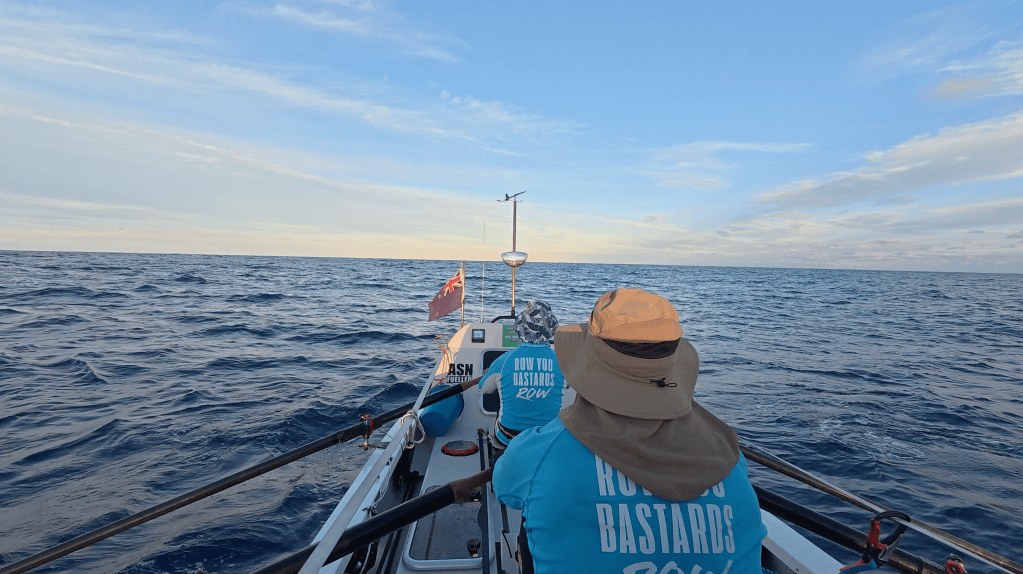
Rowing together is super tiring as even less time to rest
Our pace with two of us rowing initially was 1.3 knots and slowed during the afternoon to 0.7 knot. We battled away all day together until 7:30PM, when exhaustion overtook us. We threw out the para-anchor and rested in the cabins overnight. It was a lovely sunset that evening, the sky a beautiful deep red colour. I still managed a bad sleep being thrown around in the front cabin all night.
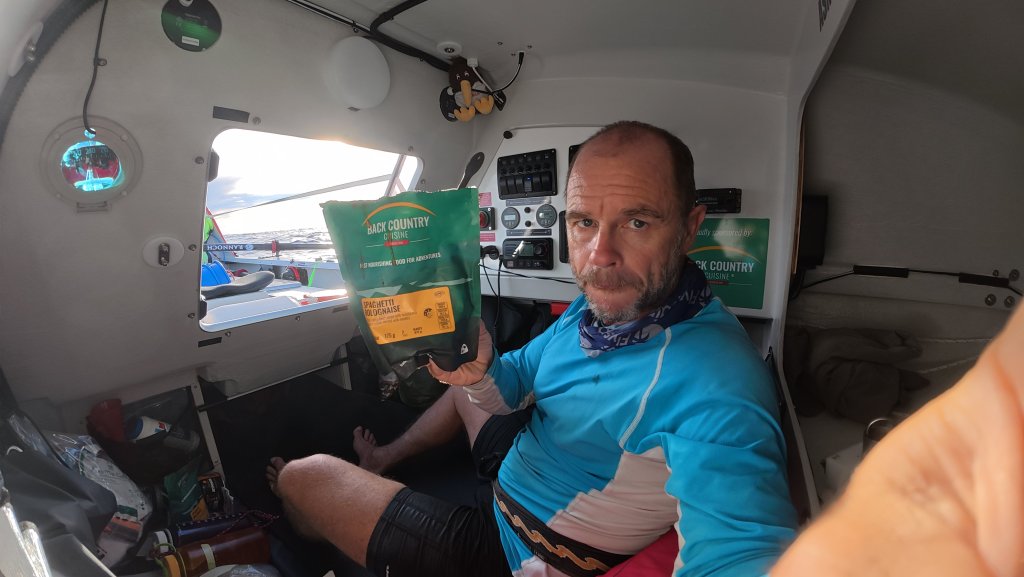
In the morning a front hit us and, as they always do, it brought rain. I was glad to get out of the front cabin after a night of torture stuck inside. Looking at our position, we realised we had lost all the hard-earned ground we had fought for together yesterday. We had been swept backwards, towards New Zealand, by 10 miles. I celebrated our loss of progress with a Back Country Cuisine ‘Big Breakfast’ meal sitting in the rain on the back deck. Then, as we were still battling wind and current, we resorted to rowing together all through the morning until 2:30PM.
It rained continuously and made life miserable. Everything was wet outside and inside the cabins. We were not overly enthusiastic about Bob’s prediction that we had 400nm more of this shitty head current to row against!
So we made a decision that turned out to be one of the best of the entire expedition. I called my good friend Clouds, and we started getting weather routing information from him as well as the legendary Bob. It wasn’t that we lost faith in Bob, both these guys are weather forecasting legends in their own rights and amazing guys. I hold them both in the highest regard. But weather predictions and routing are not an exact science and what it meant for us was that we now had two independent weather routers giving us two sets of data, combined with our own ‘in-situ’ information to aid our decision making. Clouds told us there was a large band of easterly-setting current about 1 degree wide (60nm) that we should try and get north of to find favourable currents again.
At 2:30PM, like magic, the front passed through, the rain stopped and the wind turned in our favour. Suddenly we were off at 2 knots with one-person rowing again, the southeasterly wind allowed us to make a solid northwesterly heading. Oh what a difference the conditions make to my spirit!
From my log:
“My mood is terrible when we are not going anywhere or going backwards, but it brightens up enormously when we start making progress again. Progress has such an important factor on my mood.”
We had now made around 640km since leaving NZ. Even though we went backwards overnight, we are still very happy with the progress.
Day Nine
All night we fought the strong counter current trying to push us east. We kept heading north, trying to get over the top of it. At least we had favourable wind direction from the southeast which assisted us, but the wind was not very strong and the current was overriding the wind. We battled away making about 1 knot speed through the night, generally in the right direction. Luke had a bad night’s sleep and felt tired in the morning. I had another delicious Back Country Cuisine ‘Wheat Flakes’ meal for breakfast. It is an overcast day, and the only marine life are seabirds flying around the boat.
“Whenever I see the seabirds, it always makes me think. The only one I can recognize is the albatross. Do they sleep at sea, what do they eat? Why do they always seem to be alone? Where is their offspring? What do they do during storms? Do they live out here permanently at sea? It’s fascinating.”
The day got brutally hot as the afternoon wore on and the wind dropped, slowing our progress even further as we battled north at 1 knot speed, trying to cross this counter current. At 7PM, after being roasted all afternoon under the sun, the wind picked up slightly and our speed increased to 1.7 knots. I sent a message to John, our shore-based coordinator, to ask him how long it took Colin Quincey, some 48 years previously, to get to our position on his crossing. John replied ‘30 days’. We have reached here in nine days, so we are moving significantly faster. Colin headed very far north to try and find favourable currents. He managed to speed up significantly on the last half of his trip. With the weather and current data we have today, we know we don’t need to go that far north and have so many advantages compared to the challenge he faced. He was truly an explorer.
Day Ten
From my log:
“Another very tough night due to feeling so tired as we battle across this counter current. Slow going at 1.2 – 1.5 knots. Quite a muggy night and it even rained a few times. When it rained on Luke’s shift earlier in the morning it brought some wind with it. Wind increased throughout the day, 10 to 15 knots from the southeast, and our pace started to pick up a little bit. By the early morning shift, I was very tired, struggling to stay awake, listening to an Andrew Huberman podcast, which was very boring. Really struggled through that last two-hour shift which was 4 – 6am. Luke did the 6 – 8am shift so he got the sun coming up. Then I was back on for the one-hour shifts starting from eight. But another brutal night.
We made good time and as the sun came up today, quite a bit of cloud still, but we got a much stronger southeasterly wind, which started pumping us along at two and a half knots, so for the last four or five hours we’ve made really good progress. We’ve made just under 100 kilometres in this last 24-hour period. We are now one third of the way across, 800 kilometres in total. Clouds and Bob gave us a new waypoint and interestingly, they are pretty similar. Apparently, there’s a big eddy about 100 miles to our northwest.
It gets hot in the afternoon, really hot. Have the sunshade up in the cabin. We’re thinking about the fastest crossing, which is 31 days by a crew of four. And we have that possibly in sight, but everything depends on the conditions. So, we’ll just keep on going, we are one third of the way across on day 10, there isn’t any reason why we couldn’t get the other two-thirds and be over within 30 days. Let’s see.”
Day Eleven
My log reads:
“It is 5:30 PM at night, day 11. We’re at latitude 30 degrees 26 minutes south, longitude 166 degrees 45 minutes east. It’s another brutally hot day, literally baking. The afternoon time around about 1 PM all the way through to about 7 PM is the worst, it is brutal.
Inside the back cabin in the morning the sun comes up behind us. So during the morning that cabin is quite nice. But about lunchtime, the sun gets up overhead, and then afternoon time it gets in front of the boat and starts to set. Then the cabin becomes really hot. We have the sunshade out which Luke made from a piece of car sunshade, which is fantastic. We have a fan going inside the cabin, but still I am getting heat rash and I’m starting to feel claustrophobic inside the cabin when resting, it is so hot. But we have continued to make excellent progress, our last 24-hour run was 107 kilometres.
We have an interesting week coming up. Over the next 24 hours, we should be able to keep rowing slowly. The wind is east but shifting to the northeast. We’re trying not to be pushed south at all, but we’re just entering an eddy, a big clockwise eddy, and we’re entering it from its right-hand side, so it’s pushing us southwest. We need to get another 14 miles further into it before it will start pushing us west and then another 15, 20 miles after that and it’ll start pushing us northwest as we come out the other side. So now we are just trying to work hard to get another 14 miles, which will probably take us about 8-10 hours. Then Monday that wind will shift, go around the compass and go northeast to the north, northwest, west, southwesterly, southerly and then back to easterly. So we may not make much progress on Monday before a front comes through on Tuesday.
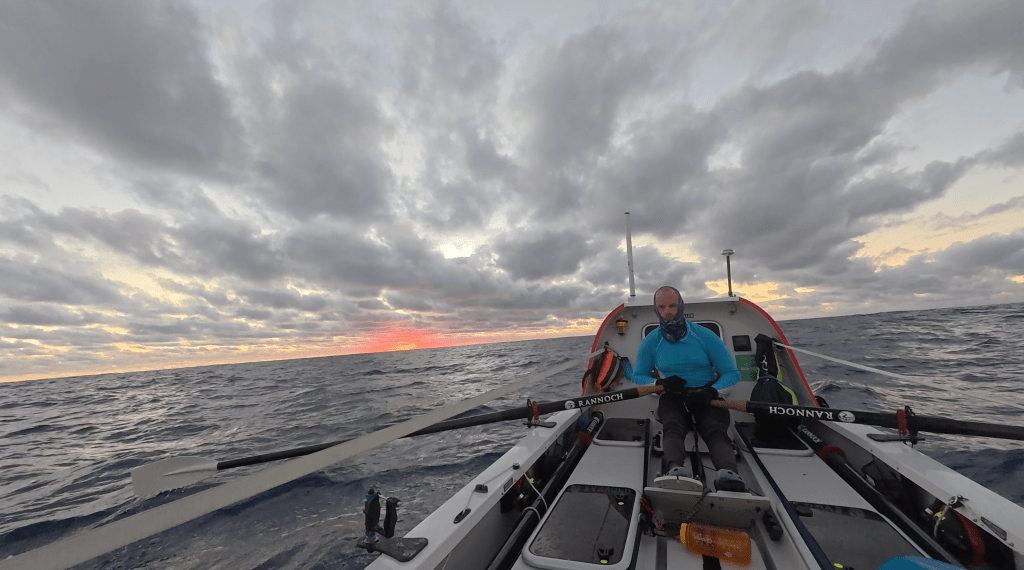
The Tasman sky shows her mood
The exciting thing after the front is that we’ve got a few days of southeasterly winds. Don’t know how many days, but 20 gusting to 30 knots. 30 knots is a bit too strong, but 20 knots southeast is an exciting opportunity to make some ground, to make some really good progress. We’re excited about that opportunity.
I feel like I have high-altitude lethargy, I seem to go into survival mode during my one-hour breaks. I just basically lie in the cabin doing as little as possible, as few jobs as possible, really feel so lazy, trying to save up enough energy to get back on the deck and start rowing again. Luke also had a bad night last night.
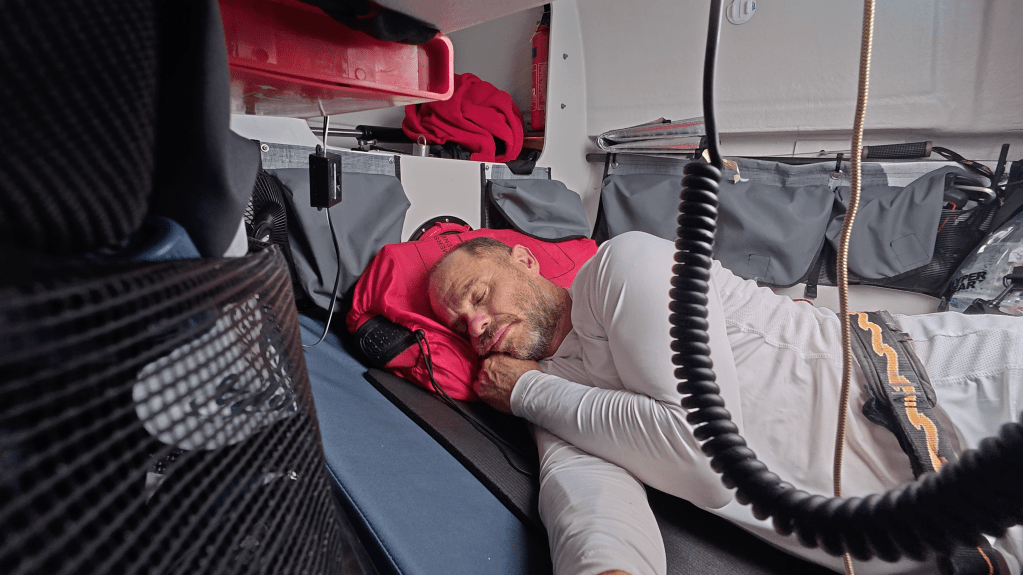
Catching up on much needed sleep in the rear cabin.
Saw some interesting marine life today. Finally some dolphins came and visited us, just for about one minute. A couple of big fish just came up to us, I don’t know the name of them. It’ll be great to have some following us along. Lots of seabirds flying around us. I haven’t seen any albatross for a long time. I am slightly on edge. On one hand I am stoked with our performance, our progress today has been fantastic, made over 900 kilometres. On the other hand, I’m always concerned about the possibility of tropical cyclones. I just want to get to the halfway point. I think there’ll be a good three days before we get to the halfway point at 300 kilometres from here.”
Day Twelve
We made steady progress through the night, tracking around the eddy just as the weather routers said.
“We see so many shooting stars here every night. It’s amazing! Sometimes we see three or four each rowing shift. In one shift I saw an airplane flying over about 30,000 feet. I could actually hear its jet engines. I could hear the very distant roar of the jet engines, and I could see the lights, one on each wing and under its belly. The first time I’ve seen and heard so clearly a plane flying at such a high altitude. Not possible in places where it’s noisy or there’s light pollution, it’s really amazing!”
We had southeasterly/easterly/northeasterly winds of around 5 – 10 knots all day and made a consistent 1.8 to 2.0 knots speed throughout. On our 2PM distance check we found we made 93 kilometres in the past 24 hours.
We are preparing for a front coming through tomorrow morning at 6am. It’s forecast to bring some rain and some westerly wind, and then at 2pm, that front will disappear and very strong southeasterly winds of 30 knots will kick in. We’re going to try to maximize that. We get the boat ready during the afternoon for rough weather. We get more cooking gas out of the lockers, more wet wipes ready in the back cabin, store and secure everything neatly. We make 20 litres of fresh drinking water. Our electric water maker has a small leak. I mop the well out and dry it all out after we finish making water.
Luke tried fishing this afternoon. We have a friendly mahi-mahi following us, also known as a dorado. A big shark swam up to the boat for about 30 seconds, about 6 – 7 foot long. The mahi-mahi I nicknamed ‘Scout’. He followed us all day. Luke pulled out a lure and tried to catch him, he couldn’t catch him. Scout’s too clever for that. We wouldn’t have eaten him but would have just released him. I was quite happy we didn’t catch him personally. I’d rather see him swimming in the sea.
I get all the camera batteries charged and ready for the rough weather. Hopefully we can ride it out and make lots of distance. If the wind is too strong, we will have to deploy the drogue or the para-anchor. Safety before speed!
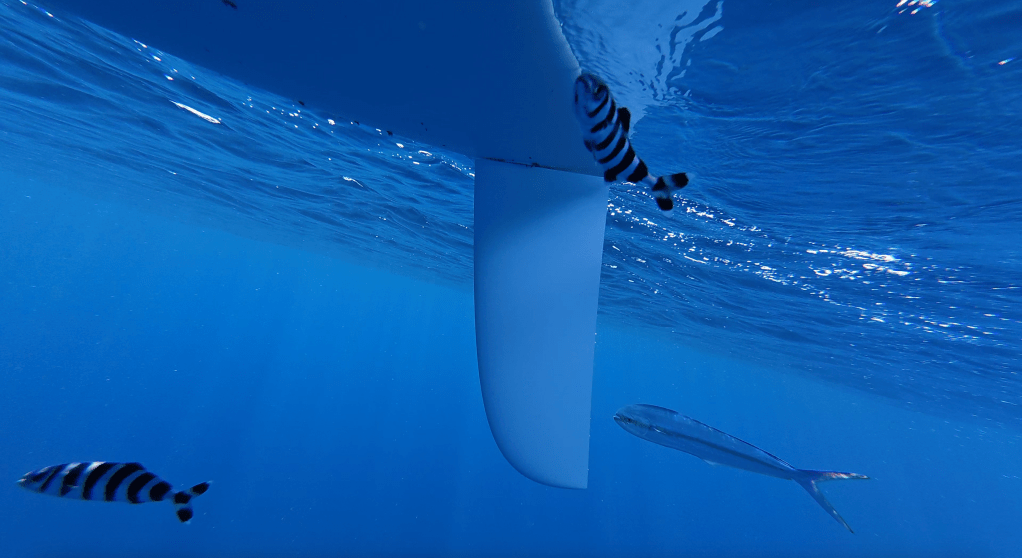
Friendly fish following along
Day 13 – Preparing for big wind
We rowed until midnight, but conditions were extremely bumpy with the wind moving to the northwest, creating a confused sea state. We were both exhausted, continually smacking the oars into our shins as we struggled to get clean strokes in the dark. It was infuriating and depressing. We were both super tired by midnight. On our shift changeover we had a chat on the back deck in the dark about the situation. We noticed when we stopped rowing we were bumping along generally in a southwesterly direction at 0.4 of a knot. At least we were not going backwards. So we decided to have a much-needed break and retired to our respective cabins to get some rest. We made sure we had the nav lights turned on and Luke monitored the AIS from the back cabin console through the night.
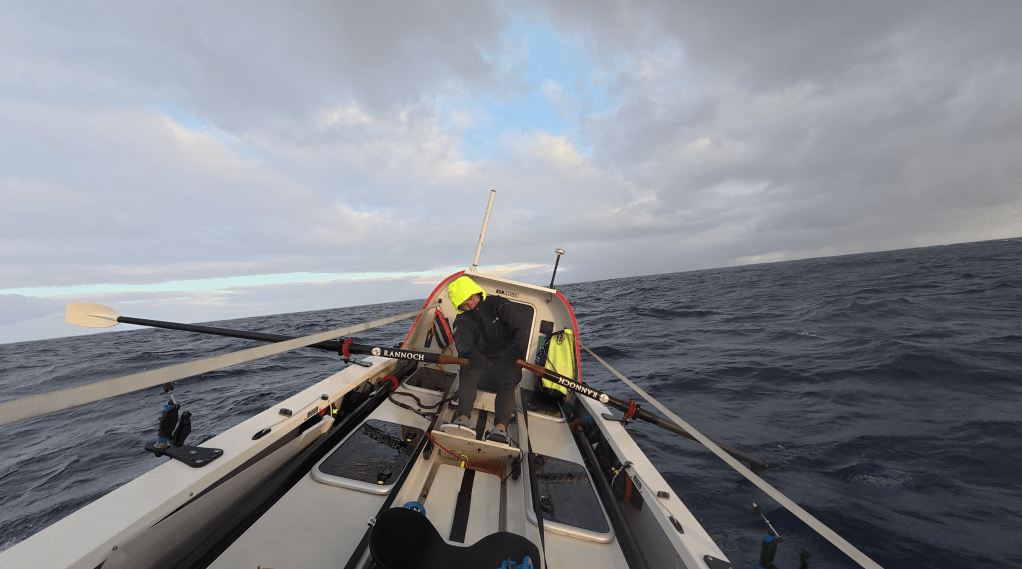
Rocking and rolling on the Tasman, in certain conditions trying to get a clean stroke with both oars is challenging.
I spent the evening being smashed around in the front cabin. It was so bumpy my rest was more like a bumpy, meditative doze as compared to falling into any form of sleep. By morning I had banged my head on the cabin roof so many times my scalp was bleeding and I was in a less than optimistic mood.
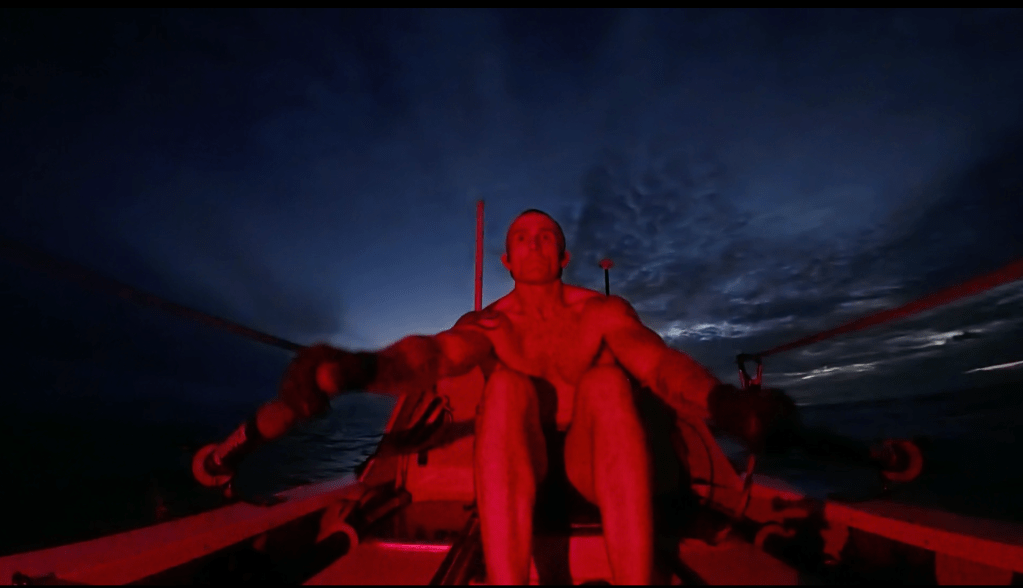
Luke on night shift with no moonlight
Luke saw a ship on our chart plotter in the night, about five miles off, the SS David. It’s always reassuring to know that the AIS is working. At 8AM we got up and noticed on the chart plotter that we had made about one mile of progress in the last eight hours, so we didn’t lose any ground.
My brain, my decision making, my memory seems to be chugging along at a much-reduced pace than normal. Luke cooked a freeze-dried big breakfast for each of us as we sat on the back deck. The wind is currently blowing from the west. We got our drogue out in preparation for the strong wind forecast later that day, then we started rowing in a NW direction. We made about 1.9 – 2.0 knots of speed for the rest of the day. At least in this boat we can make way against the wind, in the old boat it was so hard to go against the wind.
Bob sent us an updated forecast that the strong easterly winds would hit us between noon – 3pm. We knew it was forecast to blow up to 30 knots with a sea state up to 3.5m. A forecast sea state is the average size of the waves and in theory some of the waves can be twice as high as that, so we knew we needed to manage the next 24 hours carefully. We wanted to make maximum progress but not at the expense of safety.
At 4PM my log reads:
“It is 4 PM New Zealand time, our position is currently 29 degrees 51 south and 165 degrees 26 east. The southeasterly wind has just started to hit us. We’re now doing four knots of speed in a northwesterly direction, directly towards the waypoint.
We know the winds are meant to build significantly, so the big challenge tonight is what the sea state does. We are slightly nervous, but we are really hoping to run with this weather as much as possible rather than go on para-anchor and jerk the shit out of the boat. It’s hard on the boat, it’s hard on the people in the boat. Going on para-anchor puts so much shock loading and pressure through the boat.”
At 8:30PM my log reads:
“It’s now 20 – 25 knots outside. I’m inside the back cabin. Luke’s got the first two-hour shift. We’ve stopped rowing and just got the oars out the side. We are doing four knots in a northwesterly direction. Slightly intimidating when it first started picking up as there were two swells running, a southerly swell and a swell from the southeast, which made the sea confused. But now the swells seem to have kind of aligned, mainly coming in the direction of the wind from the southeast.
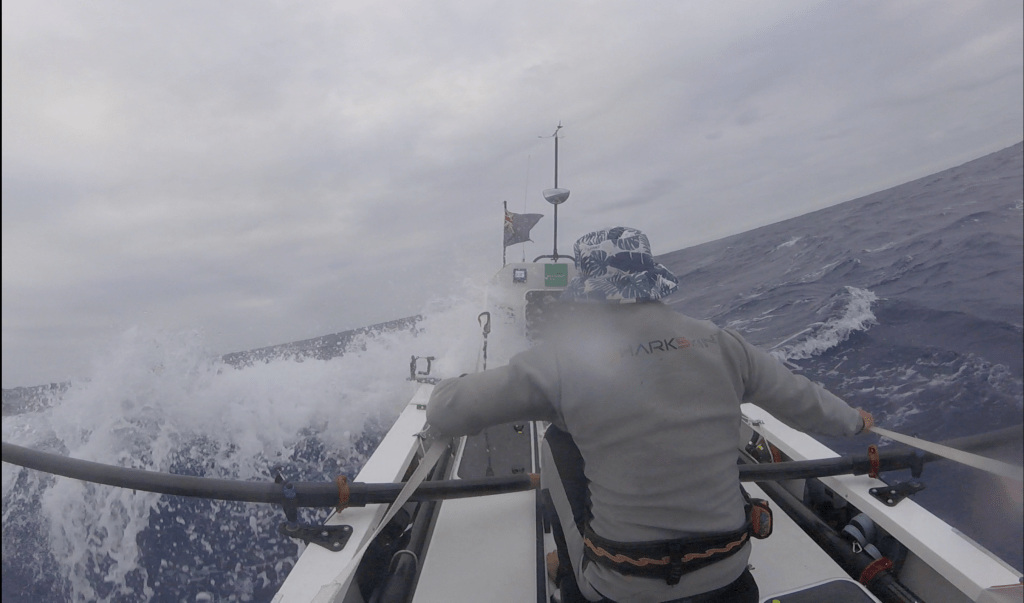
Getting pumped along at 4 knots by following wind and sea. By day you can see what’s coming, at night it’s more intimidating especially with no moon.
But the wind is definitely picking up, the sea state is getting bigger. No point rowing, we just sit on the back deck in the dark. The boat is flying through the water at four knots, constant speed. In the back cabin, it is beautiful, because we are going with the weather, the motion of the boat feels quite smooth. The autohelm is working very hard, I can hear it grinding away, but the motion of the boat feels smooth and we are just flying through the water.
Wind speed overnight is gusting 30 knots, peaking by the morning, then it starts to ramp down during the next few days to 15 knots. We need to be very careful tonight, safety before speed and just make sure that we’re not doing anything silly in the dark. I don’t think there’s going to be much rowing tonight. We have the drogue ready, the big 50 metre rope hooked up to drop off the stern if we need to slow ourselves down. We just have to keep monitoring the sea state and make good sensible decisions. We don’t want to make any mistakes in this situation in the dark, but it is very nice to capitalize on making some mileage as well.”
Day 14 – Leveraging the storm
It was an exciting night of progress, my log for day 14 reads as follows:
“It’s 7:20am in the morning. We had a windy old night with quite a bit of cloud cover at the start. It blocked out the moon and was pitch dark. The wind speed maintained a good 20 – 25 knots all night.
Luke did a shift on the back deck from 8 – 10pm and he didn’t row at all because we were being blown along with the following sea assisting, averaging four knots. There’s no point rowing, it doesn’t add any additional speed. So he sat on deck monitoring the conditions with his oars poking out the side to balance the boat.
At 10pm I came on deck, and I didn’t see much point putting the oars out. In fact, I was worried they would just catch on a wave and become dangerous. I stowed the oars and sat there for about 20 minutes and thought, “Why am I sitting here in the dark? Surely I would be safer and more comfortable inside the front cabin, half a metre from my head.”
So I climbed into the front cabin and every 10 – 15 minutes, took a look at the wind vane and the speed and checked we were lined up with the wind. At the end of my shift it was all working quite nicely. The motion of the boat is quite comfortable, even though we’ve been smashed along at four knots.
Luke was in the back cabin and we had a brief discussion, shouting to be heard in the wind and the darkness. I said, “Mate, there’s no need to go back on the deck, just stay in the cabin, do your two-hour shift from there. Monitor the wind, sea and direction from there.”
So that’s what he did for his two-hour shift and we continued like this all through the night. We made fantastic progress. By seven o’clock this morning we had made over 110 kilometres since 2 PM yesterday. This will be our biggest day by far. We could even make up to 150 kilometres today. I didn’t really sleep very much in the front cupboard, kind of dozed in a tired meditative state. The wind does seem to have dropped a bit this morning. I’ll get up and try and get breakfast going soon, I need to go to the toilet also. Bob sent a message with a coordinate where we would start to turn west and might be aiming for Tweed Heads in Australia. After another 50 kilometres, I think we will be halfway towards Australia.”
Day 15 – Over halfway
The wind swung around to the east during the night. We are still being pumped along at about 2 – 2.5 knots. I have been lying in the back cabin for so long my back is killing me. I have to contort myself into a spreadeagled ‘H’ position when I lie in the back cabin to stop being thrown around and it is just terrible for my back. We are now closer to Australia than we are to New Zealand so it’s all downhill from here!
Our shore-based project manager John released the first public blog today about our crossing. We had agreed with him to wait until we were over halfway before going public.
The wind speed drops to about 10 knots during the day, still from the east. We are informed by our weather gurus we have a large eddy in front of us and we need to make a decision how to get around it. One router suggests going south and the other suggests going north to get around it. This is the beauty of having two routers, we have options!
My log at 10:30am reads:
“I’m determined that I have to start enjoying the experience more, being present in the moment, really appreciating being out here because I’ll never be back out in the Tasman again in a rowing boat. This is my fourth attempt, I have to get there this time. These ten days of my life coming up now are going to be very special. I want to absorb them, be present in them, live in them, appreciate the experience. Try and feel it and create memories that I can hang on to for as long as possible.
I just sent Stephanie a message saying that we may be there significantly earlier than what I’d initially told her. I initially told her 40 to 60 days, but we might be there in more like 30 days. I said, look, no pressure, you don’t need to fly all the way from Thailand. I’ll be quite happy finishing the journey just by coming in safely and having a quiet arrival, shaking the customs people’s hands and having a night in a hotel to go to sleep and then wash the boat the next day and cycle back down to Ballina with my bicycle to make the line between Singapore and NZ complete. Just to make sure that the journey is connecting all the dots. Or maybe I should continue cycling across Australia and head back to Singapore the other way?”
At 10pm I wrote:
“We have now made it over 1,300 kilometres from New Zealand, well over the halfway mark now. It’s been a very good day. The wind swung around from southeast to our east, and we managed to head west for about 20 miles this morning up until about 4 o’clock. Now we must get around this eddy in front of us. With the weather routers telling us different options, one said turn north, the other turn south, we first tried turning southwest and to our very pleasant surprise, the boat seemed to handle it. I gave mum and dad a call on the satellite phone at 3 o’clock this afternoon to let them know we were over the halfway point.”
To be continued in part 3……


Leave a comment