
It has taken 12 months to put pen to paper to share my Tasman Sea crossing blog. I needed time to distance myself from the experience, to gain clarity on what it meant for me and to be able to write something that reflected my overall feelings about the entire project, as this was much bigger than the Tasman itself.
Crossing the Tasman was the culmination of a project to connect Singapore and New Zealand by human power. In 2017, together with my teammate Charlie, we rowed 4500km, over 78 days and nights from Singapore to Darwin in Australia. From there I continued solo, cycling for 45 days and 4000km across the continent of Australia to reach Coffs Harbour on the East Coast of Australia. From Coffs Harbour I made my first solo attempt to finish off the project by rowing across the Tasman Sea to New Zealand. That attempt ended 24 days and 2200km later, when I was washed back into the shores of Australia in a place called Ballina. You can read more about that attempt here.
I then re-strategized and opted for a different route – the southern Tasman. I cycled south from Ballina down the New South Wales coastline for 1300km to the small town of Eden nestled on the south-eastern tip of the Australian mainland. Here I made attempt number two, also solo. This also ended in failure on day five, where just 200km from shore after multiple capsizes and equipment failures, I abandoned the attempt and was picked up by helicopter. You can read about that attempt here.
After another brief rest I made attempt number three, also from Eden. But this time with a rowing partner, Luke Richmond, who joined me. We strengthened the boat in critical areas and set off, however after a violent capsize event in the Bass Strait when Luke was rowing, we decided to abandon the attempt and return under our own steam to shore. I had lost confidence in this particular rowing boats design for the Tasman Sea crossing. It capsized too easily in heavy weather, behaved terribly on parachute anchor (violent snatching from side to side) and had too much windage for a route like the Tasman. It was designed as a downwind, trade winds Atlantic boat, and the Tasman requires a boat you can at least make some way against the weather.
I had always had an idea in the back of my mind that a peddle powered boat would be efficient and maybe more fun and less tiring than rowing? So I decided to work with my boat builder to design and build a peddle powered boat, specifically to cross the Tasman. Unfortunately, an unexpected event called Covid slowed down the entire design and build process by about three years. I couldn’t even get to the UK to test and view the boat for two years. But finally the “Little Donkey” was born.
Again with Luke Richmond, we tested her on a 2,200km crossing of the Bay of Bengal, from Phuket in Thailand to Sri Lanka. Whilst she proved seaworthy, the pedal drive system was far from robust, required continuous servicing at sea and I decided that would not be the boat for the rougher waters of the Tasman Sea. It was a fantastic adventure though, brutal, painful, uncertain and epic. You can read about that one here.
So, in March 2025 the plan was back to rowing again. Together with Luke, we decided to reverse the route and take on the northern Tasman which runs from New Zealand to Australia. Over the summer months this route has a period of favourable predominantly south-easterly winds. The big negative for this route is that this period also coincides with the tropical cyclone season. Some years there are none but as I write this in 2026 there has been a nasty run for a number of weeks of terrible weather. When these cyclones hit they are intense, and not a good place to be out at sea in a rowing boat. We decided the wisest plan was for us to try and depart towards the end of the cyclone season, when the chances of a cyclone were lower, but not before the SE winds had entirely dropped off.
With this in mind, mid-March 2025 was the chosen start date. With an expected crossing time of 60 days and an optimistic time of around 40 days, we opted for the Rannoch R25, two-person rowing boat built by Rannoch Adventures in the UK.
As well as timing of an ocean row, two other major considerations are departure and landing. Where we depart, we have complete control over, not so with where we land. We had four data points to work with in terms of previous crossings. All previous four attempted crossings had started from the northwest coast of New Zealand. The West Coast is prone to large nasty river bars, with large surf breaks making departure from shore perilous. Out of the four attempts, one of them ended in 30 minutes as the boat got smashed in the surf as they attempted to depart. Another attempt ended after just a few days after a capsize. A third attempt opted wisely to be towed out through the bar (technically this meant it was an assisted crossing which was something which went against my human powered principles for this trip) so that left only one crossing which had managed to safely depart the West Coast under their own steam, Colin Quincey, way back in 1977. Reading his book and speaking to him about this, his departure was a stressful experience that I wanted to avoid.
So based on all that I decided to make our departure as stress free as possible. And after some research we chose to depart from the more sheltered northeast coast of New Zealand from a small bay called Houhora. Technically this meant we started on the ‘wrong side’ of New Zealand and would add more distance to the journey, requiring a favourable weather window to depart (with southerly winds followed by easterly to get up and around the top of NZ), but it removed the stress of dealing with the west coast’s large breaking surf, in a one tonne, human powered boat on day one of the trip.
After speaking with a handful of people, I quickly realised that sharing this idea was not a good idea. After a chorus of “Do you know how rough the waters are up there’, ‘How are you going to get around the top of New Zealand?’, ‘Has anyone done this before?”, these reactions encouraged me to make the entire project incognito. Not a word mentioned publicly, no pre-departure send-off parties, no media, our plans were shared purely with mission critical team members only. The less people that knew the better.
Departure
I flew to New Zealand to meet Luke and moved to our basecamp, just north of Auckland where we were storing and testing the boat at a small beach away from public eyes. The plan was I would arrive on 3rd March 2025, then we would have 8 – 9 days testing and preparing the boat before a planned departure on the 11th or 12th March.
After an overnight flight from Phuket to Auckland, Luke and I got straight onto the water for one last sea-trial, (we had previously tested the boat on the water in the UK including roll tests). We rowed for a full day then anchored for the night to test the sleeping arrangements. The boat has two cabins, and I slept in the front cabin with Luke in the aft cabin. I had a terrible sleep, and after the previous overnight flight from Phuket to NZ, was very tired when the sun rose the next day. As we would later discover, the front cabin of the boat is higher than the aft cabin and considerably more bouncy and harder to sleep in.
We had been monitoring the weather closely as we got closer to our departure. On the other side of the Tasman, southern Queensland and northern New South Wales were being smashed by a huge and slow-moving tropical cyclone called Cyclone Alfred. A rower crossing the Pacific got caught in this and capsized multiple times before being rescued by the Australian Navy.
We needed a specific wind pattern for departure of southerly winds for a day or two then switching to south easterly as we rowed up the east coast and then around the top of NZ to start heading towards Australia. When we got to shore the morning after the sea-trial, we saw an amazing weather window the very next day for departure!
There it was. The cyclone in Australia was causing a massive suck of air and giving us favourable winds from NZ. If we missed this opportunity the foreseeable future looked bad. The problem was we were not ready to depart the next day. But after a quick chat we decided this was our opportunity.
The next 24 hours were a mad rush as we arranged with customs and immigration at Opua to go out of their way to especially travel up to Houhora to meet us and clear us out. They were amazing and told us they were super busy but if we were there at 1400hrs they would also be there for 15 minutes to meet us and do the job. But we could not be late!
We had to pack all our food and gear, drive the 6 hours all the way up to Houhora and arrange our support team (some of whom were in Wellington) to urgently fly up immediately to help us depart. That evening I also had prior commitments to deliver two keynote speeches virtually to almost 2000 people. As the audience was in Europe, this kept me up most of the night, so come 6am the morning of departure I was now super tired and running on empty.
But now the real work started. Luke drove while I tried to rest in the car for 6 hours, towing the boat all the way to Houhora. We arrived just before 1300hrs and so began a frantic one hour of packing of the boat. Customs and immigration processed our departure as promised at 1400hrs (thanks guys), a hug with our two support crew Mark and John who would drive the vehicles and trailer back home (thanks guys!) and at 2:05PM on the 6th March 2025, we launched Pavlova, pushed off from shore and started rowing.
Luke took the oars and I flew the drone to capture our departure. As we rowed out of the beautiful Houhora harbour, we could not believe how we had managed to pull this off. What a relief to be on the water. The adventure can begin!
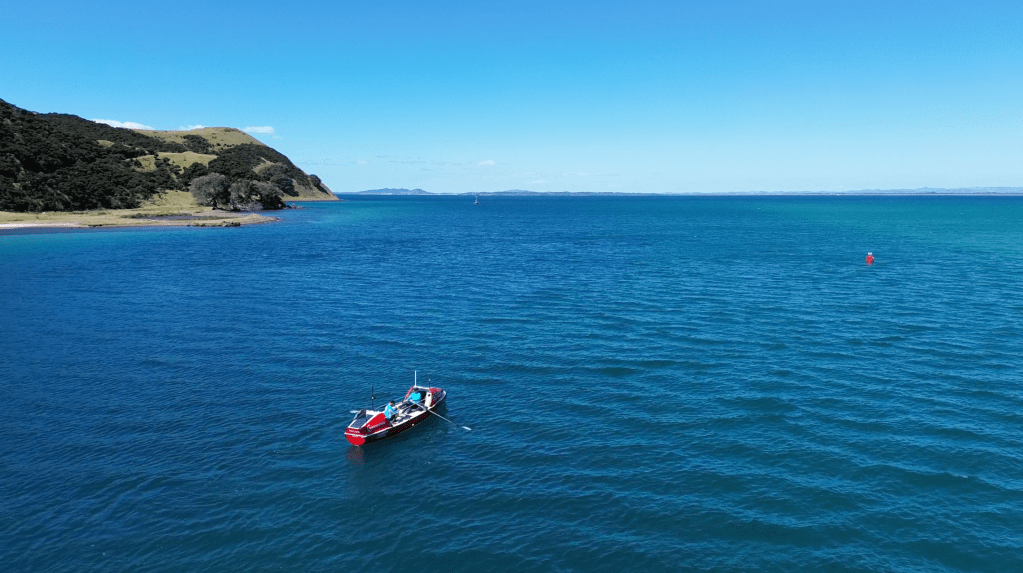
Departing Houhora at 1405hrs, 6th March 2025
Day 0 -> 1 – Rounding the top of New Zealand
We had planned for 48 hours to get the 100km north to Cape Reinga and clear the the northern tip of New Zealand. As we rowed out and left the safety of the harbour and started heading north, the views were beautiful but my feelings were all over the place.
My log captures my feelings:
“I can’t believe it that we got away in what we hope is very good weather. We have been at sea for five hours now, made a great start coming up from Houhoura, averaging about three knots, got some beautiful current and some wind behind us pushing us north up to the verytip of New Zealand. It’s a little bit bumpy and I’m a little bit nervous, to be honest, nervous and scared at the moment. trying to get used to my new environment. Let’s see, I’m nervous about what the northern tip of New Zealand is going be like to get around it. Nervous of failure, nervous of storms, nervous of lots of shit and I’m tired too, so one step at a time, one day at a time, let’s see how it goes.”
The plan was to row in shifts two hours on and two hours off through the night. Owing to our great progress, with the tail wind and favourable current, by midnight, after only 9.5 hours we were rounding North Cape, New Zealand’s most north eastern point. The decision to leave from Houhora started to feel justified as we started to aim the boat west. We still had to get across Cape Reinga, then around the Three Kings Islands which we toiled away at for the rest of the day.
The Manawatāwhi / Three Kings Islands are a group of 13 uninhabited islands about 55 kilometres northwest of Cape Reinga, New Zealand, where the South Pacific Ocean and Tasman Sea converge. Our initial plan in conjunction with our shore-based weather forecaster Bob McDavitt was to head south of the three kings, but as the evening of our second day at sea (officially this was day one as I start counting the first day as day zero) we were being pushed directly towards the islands. Not wanting to be anywhere near them at night, we changed plan and set a way-point further north. Through the night we were careful to work our way safely past them, passing them well to our south.
Day 3 – out into the Tasman
My log for day 3 is short and sharp, I was by now very fatigued and struggling to keep up mainly due to starting the whole row severely sleep deprived and fatigued.
“It was a very tough night.
Throughout the early hours of evening the wind blew at 3 knots
The current changed as we approached Three Kings Island and we ended up passing the islands in the middle of the night, some 18nm to the north of them.
Night shifts are very long and I struggle not to fall asleep when rowing.
I have very little energy.
So hot during the day so we decided to change to one hour shifts during day and 2 hr shifts at night.
Big ship came up from the rear
We saw them on our AIS and contacted them on our marine VHF radio to check our communications systems was working. All ok”
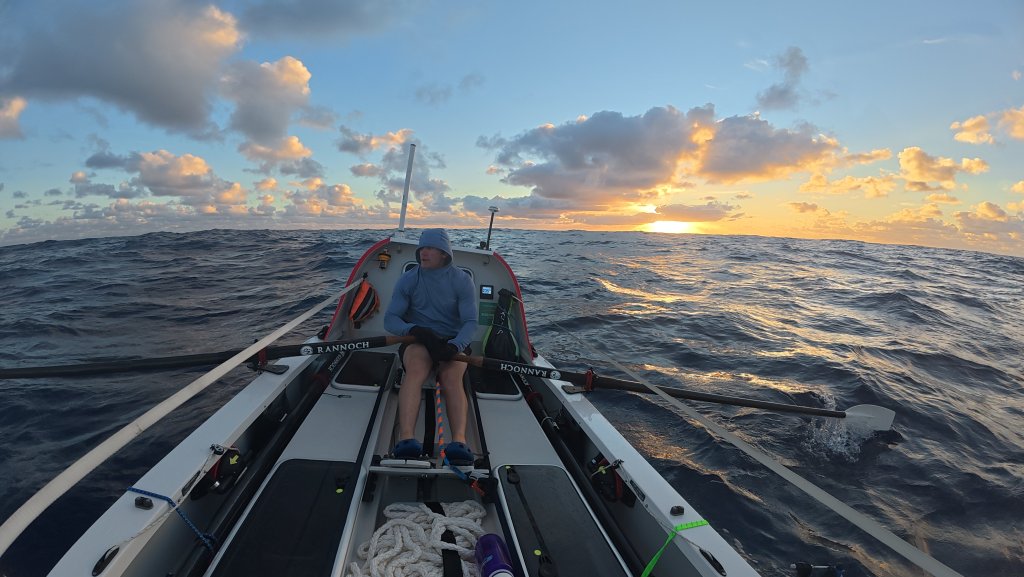
Day 4 – settling into life at sea
Log from day four.
“It’s day four, it is 11am in the morning, but finally last night, I had my best night shift. I felt the strongest I have felt out of the whole trip right now and managed to micro nap during off shifts, so slowly feel a little bit stronger, so yeah, I could get through my two hour shifts, okay.
We are making a direction kind of more NW at the moment, heading to our waypoints. We’ve been using the autohelm (the autohelm steers the boat automatically without our input) ever since we started and it is just working absolutely beautiful, it’s taken so much effort of steering away from us. We just input the bearing and it’s working beautifully.
Last night the wind picked up a bit, some beautiful stars but there was a little bit of cloud later on. In the morning the wind picked up more and a couple of small showers came through.“
We change to one hour shifts during the day and two hour shifts at night as we find it too hot to row for two hours continuously during the day. Initially the current pushes us too far north, but as we got through the night it turned nicely. The wind picked up to about 15 knots, so the sea started to pick up, and was coming beam on from the south.
“We managed to make direct progress towards our waypoint all night, we will hit the waypoint in an hour and a half time, and over the course of the next night when the sun comes up tomorrow we are slowly gonna head west towards the Australia. In this last 24 hour period, we would have made maybe about 90km, super progress, so now we have made 300 kilometres in three days and that it is amazing. Very happy with that. Today is the bumpiest It’s been so far, two and a half metres swell from the south. It’s kind of beam onto us so bumpy as hell.”
Day Five – the capsize
Although I managed to recover a little energy on day four, by day five I was feeling deeply fatigued again. All through the day we rowed in one hour shifts and as the late afternoon approached the wind speed started in to increase and the sea state started to pickup. We were making good progress rowing at over 2 knots of speed but the seas were coming in, beam-on (from our side at right angles to the boat which is the most dangerous in terms of capsize).
I had the 5PM rowing shift and on my shift I was watching the swells come through over my right shoulder. As the swells increased in size they were occasionally breaking with the tops collapsing into tonnes of foaming agitated white water. In my fatigued state I rowed on, mesmerised at the spectacle that was unfolding.
I noticed out in the distance a swell coming through that was larger than the rest. As it got closer to me, it seemed to catch up with another swell and grow in size. The face started to steepen considerably when it was still 30m away, I remember thinking “For fucks sake, I hope we get over this before it breaks”.
That was not the case and the last thing I remember seeing was looking up over my head at this huge, dark green wall of vertical water, 3 times higher than the top of the boat. It broke right on our boat with an impact like a high speed car crash. The boat immediately flipped over, I was thrown over the side completely under water and underneath the boat for a few seconds of panic. As the wave passed through, my head popped up for a breath, and I found myself in the water but with both hands hanging onto the jackstay on the side of the boat. Then I felt the most incredible surge of power as I was wrenched out of the water and flung back onto the deck as the whole boat self-righted. It felt like an invisible hand was pulling me back up into the boat, such was the power of the force of the boats self-righting. I have to give massive credit to the boat builders and designers here, (Rannoch Adventures), as feeling the force of the self-righting was so impressive. There was nothing that was going to stop the boat rolling back over the right way up again!
Once back up the right way, we assessed the damage. Luke had been trying to sleep in the cabin, fortunately with the door tightly shut. He had taken a couple of large knocks on the head when thrown against the roof. We lost his water bottle overboard and one head torch, but this was the only damage we knew of at the time (Later on we found Starlink stopped working as well, so this was the end of our high speed comms for the rest of the trip).
The first thing we realised was that we were in a dangerous situation, we needed to get the parachute anchor out to steady the boat and avoid another capsize asap. So with some farting about, we had the para anchor out and soon it was working as per design, holding our bow into the oncoming waves. I was quite shaken after the incident. Even though I had capsized 5 times before in my older rowing boat, I had always been in the safety of the cabin at the time. This this was the first time I had capsized while being on deck and seeing and feeling the size and power of that vertical wall of green water intimidated me.
Day Six: Settling back in after the scare
My log shares my feelings on day 6 after the capsize:
“On Para anchor all night since 5PM.
Still bumpy as hell with 25 – 30 knots of wind so put para anchor out in steep seas.
Took a while to get para anchor sorted,
I got into front cabin, Luke got into back cabin.
It was bumpy as shit and I was really getting thrown around in the front cabin.
Every two hours through the night we would poke our heads out each cabin and have a pow wow about the conditions.
Got a message from Metbob that the wind was meant to drop by midnight.
It did start dropping. But we both so tired and didn’t want to get out on back deck in the dark and try and retrieve para anchor in those conditions.
We decided to leave it until 4am when it had calmed down a little bit
Sleep was non existent
My face was getting sore from rubbing against the floor of the cabin
I am being thrown around the cabin in three ways.
The first is rolling continually left and right.
The second is when we go over a wave and the feeling of the weightless as we drop.
And the third way is the violent jolts from the parachute anchor ‘snatching’ and coming tight, throwing me against the walls of the cabin.
On our 4AM pow wow we decided to wait for sun to come up.
And agreed to reconvene at 7am.
Fortunately during these three hours it calmed down a lot.
It was still bumpy but I managed some short periods of sleep
At 7am got up and pulled para anchor in. We saw from our drift we are heading in the right direction
The wind then swung around to the south east
I feel better than the night before when I lost confidence after the capsize.
I had to take my girls photos off my phone as the screensaver as it makes me to sad every time I look at them,
I got on the oars first and rowed for an hour
Conditions much better
We had a good talk about safety
Why we capsized yesterday due to two reasons:
Too tired, pushing too hard and rowing too hard which caused me to stop making decisions.
What we decide to change:
1. If big wave coming call ‘big wave’ so person in front cabin is aware.
2. Don’t get so tired we stop making decisions – don’t be afraid to stop rowing and use para anchor, drogue etc for a rest.
3. Remind ourselves that better decisions not brute force will get us across the Tasman safely.
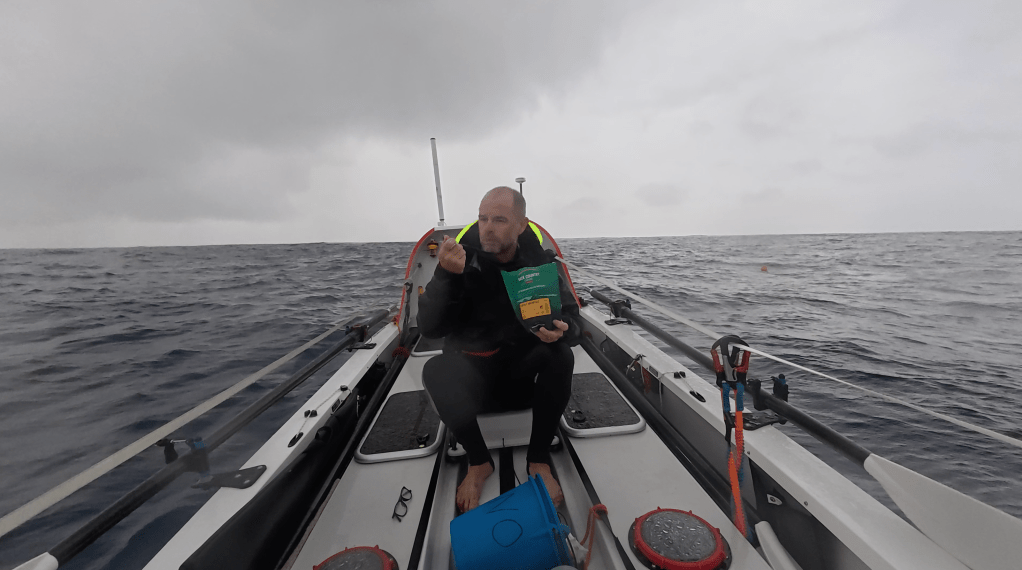
Back country cuisine breakfast – I love their freeze dried expedition food.
As the day wore on we ended up making about 55km which was not bad considering we were on para anchor for 12 – 14 hours of night.
We have now made about 360km from NZ and have a beautiful 7 knot tailwind. At 1400hrs we tried Starlink and found out it no longer worked. It had been damaged during the capsize. We had 2 x Garmin Inreach communication systems plus a sat phone so this was not an issue, it just meant we could not see detailed weather info ourselves and instead had to rely on our weather forecasters.
The day settled down the further we got into it. I messaged Bob and told him he was doing a great job with this better weather. He replied “don’t tempt fate as there a front moving through Friday!”.
As evening approached and the sun set, I notice my fatigue is at its highest and I question what I am doing. I seem to get a bit nervous going into night time.
“It’s 8:30pm. It’s been just an amazing day with the conditions. We’ve had a seven knot tailwind from the southeast, all day, following swell about one and a half metres from southeast, so really pleasant conditions to rest in the cabin and row have been making between 2 to 2.5 knots consistently all day. So very blessed with the conditions. Luke’s doing his first two hour night shift.
It’s a beautiful night. The moon looking fantastic. It’s a three quarter moon. Looking up the moon, I can’t help but thinking how isolated our position is here. What it would be like to fly to the moon and stand on the moon? How isolated, you must feel out there. We feel isolated here in the ocean in the middle of the Tasman. Almost 500 kilometres to New Zealand, 500 kilometres offshore. We’re getting close tomorrow to being the closest point we will be to Norfolk Island to our north. I spent half an hour after my shift in the cabin this evening, doing my personal hygiene, took my dirty clothes off and had a wet white bath. I cut my fingernails and basically, yeah, used about five wet wipes to clean as many parts of my body as possible. Generally body feels pretty good apart from my feet inside my crocs have been rubbing around my toe area. I bandaged up my toes and am thinking about maybe cutting one of my shirt sleeves off to use as socks. I will think about that tomorrow.
Tomorrow the wind tends to the south and we may be punching into some counter currents. So this way point tonight we’re heading to is still 21 kilometres away. Hopefully we’ll get there by tomorrow morning if the conditions stay as they are, and then will we turning more west, something north of west anyway and as we head to the next way point where we our good friend, Bob said we may encounter 0.4 of a knot current against us tomorrow. He also says the winds will be shifting to the southwest, so might be a slow day tomorrow, but let’s see.
Day Seven – hitting a roadblock
Day 7 was a slow day. My log reads:
“It’s day seven lunchtime. Overnight we had a good run up until about midnight. But then, we started hitting a counter current, of about 0.45 knots, which Bob had told us we were going to run into.
The wind also died down a lot. It was mainly coming from the south, not really assisting us anymore so progress really slowed. I didn’t manage to sleep very well at all last night, so I didn’t get any good rest. That made me very tired during the night shifts coupled with the low mileage of around 0.7 to one mile per hour. This meant a long night, tired by the morning, not in the best mood.
Sent MetBob sent a message this morning and asked him when the next favourable current is and he said it was eight degrees away in longitude, that’s about 400 miles, which was a very big surprise! That’s one third of the distance of the Tasman to find a favourable current?
I’m not sure what he’s talking about so uh that annoyed me even further. Today is a beautiful calm day, calmest we have had so far. Not even a breath of wind. The Tasman looks like a lake. We just got passed by a big cargo ship. I had a quick call to them on the radio, got a Filipino guy who confirmed that the AIS is all working okay.
Had a yoghurt and muesli for breakfast and I need to catch up on sleep that I definitely need because I’m feeling so tired. Water maker has a small leak but nothing too serious. I’m trying to also make a sat phone call to Met Bob to try and understand what he’s talking about with no favourable currents at all the next 400 miles. That’s a bit annoying.”
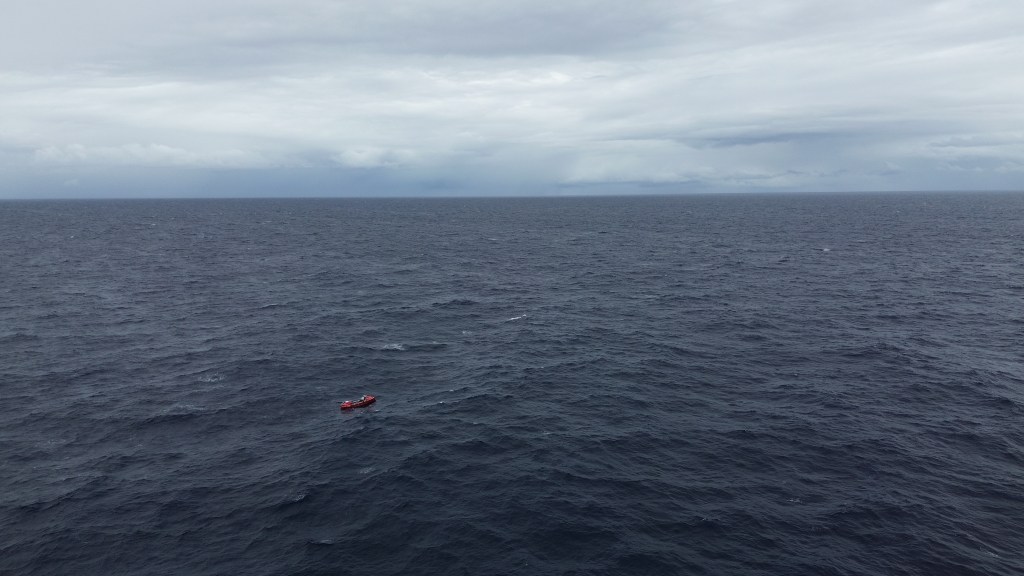
To be continued in the next blog………


 Grant 'Axe' Rawlinson
Leave a reply to Grant ‘Axe’ Rawlinson Cancel reply