
H.A.P.E = High Altiude Pulminory edema.
High altitude pulmonary edema (HAPE) is a life-threatening form of non-cardiogenic pulmonary edema (fluid accumulation in the lungs) that occurs in otherwise healthy mountaineers at altitudes typically above 2,500 meters (8,200ft).Some cases, however, have been reported also at lower altitudes (between 1,500–2,500 metres or 4,900–8,200 feet in highly vulnerable subjects), although what makes some people susceptible to HAPE is not currently known. HAPE remains the major cause of death related to high-altitude exposure with a high mortality in absence of adequate emergency treatment.
(Source: Wikipedia)
The last two posts to my blog have been brief. These have been created by me sending short 120 character SMS messages (at 6000m in -25 degrees at night in my tent using Satellite phone) to David Lim in Singapore who updates the blog. So for the people who have commented why the posts are so short, now you know why!
After spending 5 days at 5150m at basecamp, we left on what turned out to be an aggressive acclimatisation cycle. Instead of the 3 or 4 rounds of cycles that many teams do, we were informed that our plan was to do one big push up to 7500m, then return to basecamp and wait for a summit opportunity.
The first night we trekked 9.5km up 600m of height gain to 5750m to our Interim basecamp, or what I quickly renamed ‘Yak Shit’ camp. Yak Shit camp is located smack bang in the middle of the East Rongbuk Glacial moraine and tent platforms are made by hacking into the ice and rocks. Unfortunately the yaks need to sleep here as well, and as space is a premium, the entire area is covered in yak shit. Growing up on a farm – a little cow shit to sleep and eat on for two nights does not put me off too much, however its not the most pleasant camp I have stayed at.
I arrived at Interim Camp with a stunning headache and some impressive nausea and spent 2 hours loading up on water and Ibuprofen whilst grovelling away in my tent lying on yak shit. I felt good enough after 2 hours to eat one spoon full of pasta and mug of tea before disappearing back into my tent and sleeping bag for a beautiful nights rest only to be woken every 45 minutes by the need to pee (a consequence of taking the high altitude drug Diamox) or by the feeling I was suffocating (Cheyne-styokes breathing).
After a rest day at Interim Camp we then pushed on for 5.5 hours upto Advanced Basecamp (ABC) at 6350m. Another 600m vertical climb in boiling 33 degree heat – however nothing could have prepared me for the heat that we experienced once we arrived at ABC. Once again I arrived with a headache, promptly took a mug of boiling water (all the water is made from melting ice and is boiled for hygiene purposes. However it is too hot when you get it to drink which is quite frustrating when you are feeling so thirsty). Diving into my tent, I stripped down to my underwear, put on my sunglasses and sunscreen (as even in the tent and heat and reflection of the sun off the snow will easily burn you) and popped more Ibuprofen to ease the thumping in my head. At 4PM the sun dip’s down below the North Col and the temperature would drop from +33 degrees to -15 degree Celsius in the space of a few minutes.
The next day at ABC I lay in what felt like a microwave oven all day until 4PM when the sun left. I then felt bold enough to emerge from the tent and huff and puff my way for 30 minutes to the top of the hill above ABC where you can see the entire North Col and the climbing route up it. It was an impressive site, around 400m of steep snow and ice and I was excited about finally getting onto something more technical.
The following day I felt well enough to wander upto the base of the col, strap on my crampons and climb up some rope lengths till I reached the memorable height of 6666m. I then wandered back to basecamp in the sweltering heat, feeling quite tired and thirsty by the time I returned from my 4 hour jaunt. I popped the now familiar Ibuprofen and drank some water.
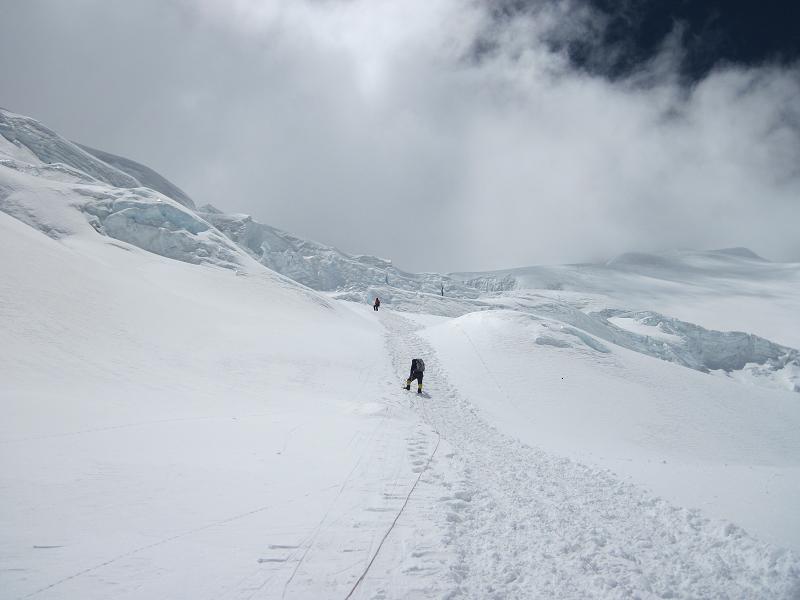
It was about this time that I first thought to myself that I had pushed the acclimatisation enough for the first round,and wouldn’t mind descending to basecamp for a rest. I felt a little tired and that I wanted to use the climb high sleep low principle more. However during dinner that night it was decided we would all ascend to the North Col Camp at 7050m tomorrow and spend 3 nights there. I thought to myself that this is going to be hardwork, especially hauling all my gear (some team members use personal sherpa’s to carry the bulk of their gear – a good idea it seemed to me as I lay in my tent thinking of the next days task).
The next day with a laden pack, I set-out with Jim. We had been getting long well on the trip and elected to climb to the Col together slowly as we would be both carrying our own gear. After 45 mins I knew something was wrong. I could not keep up with the very slow pace that Jim was setting, I put this down to the fact that my pack was too heavy. So reluctantly I returned to ABC and spoke to team leader Jamie about the fact I was struggling with the heavy pack. He asked what I would like to do and I said I would throw out all absolute non essentials and try again early in the morning before the sun came out. Jamie kindly offered to carry up my sleeping mat and cooking pot to save some weight also.
I then lay in my tent for the rest of the afternoon, nursing my by now continual headache (a couple of Ibuprofen helped – man I love that stuff) and I noticed two things.
- There was a rattling sound in my chest when I breathed deeply
- I was feeling extremely lethargic and lacking energy
- I was struggling to catch my breath even at rest
As the rest of the team was up at the North Col I had dinner alone in our small dining tent. But I had zero appetite and forced down 3 pieces of broccoli and some hot water before disappearing into the bliss of my sleeping tent at -25 degrees (-25 degrees at 6300m elevation feels much colder than it does at sea-level!)
At 4AM I realized I had a serious problem. I needed a crap. The crap was not the problem. Getting up out of my sleeping bag and putting on all my down and walking down the 5m to the toilet tent left me gasping for breath as if I had just been through a boxing round. I felt like I was suffocating and continual panting did not seem to relieve the situation. I also noticed my breathing was making more pronounced gurgling noises and I coughed up a huge ball of bloody spit. I am not a doctor but have read screeds of information about altitude sickness and the different forms and symptoms. I immediately knew that I was suffering the initial stages of H.A.P.E.
Lying alone in your tent in freezing conditions at 6350m knowing you have serious altitude sickness is quite a lonely experience. I was in two minds: I knew the only effective cure for H.A.P.E (which is deadly), is to descend immediately to a lower altitude fast. But I also knew that team leader Jamie who was higher up on the North Col would not be in radio contact until around 7AM, at which time he could arrange for some assistance to help me down the mountain.
As I lay there I could feel myself getting weaker by the hour. Should I wait for 4 more hours or should I head off down in the dark by myself? I decided to wait but it was a long 4 hours lying in my sleeping bag, not sleeping a wink until the sun hit the tents.
Jamie immediately confirmed over the radio what I had self diagnosed. He had one of the Tibetan crew carry my pack with some water and food and a Sherpa name Nima to carry oxygen and walk with me. As I sat in ABC waiting for the guys to make some last-minute preparations I took the opportunity to inhale bottled oxygen. Whilst descent is the only reliable cure – breathing bottled oxygen is the only other really effective thing which can temporarily assist with the symptoms of H.A.P.E until which time as you can get low enough to recover.
At 7:30AM we left ABC. We had a short 30m uphill scramble to get onto the moraine ridge to get out of basecamp. This was where I knew I was in more trouble than I realised. I had no power at all in my body to move uphill, and every step upwards left me gasping for air as if I was suffocating(which was in fact what I was doing). It was an awful sensation as I staggered up the hill, 2 steps at a time then bend over my trekking poles gasping for air and spitting bloody phlegm into the snow. The continual thoughts that if I did not descend then I would die however was a strong enough motivating force to keep me going.
I could just manage to stumble slowly downhill under my own power, however any uphill sections left me bent over my poles gasping for oxygen feeling like someone had taped up my mouth. We soon developed a routine where I would stumble along for 45 mins until I was too exhausted to walk further. Then I would collapse onto a rock and Nima would hook the oxygen mask over my face for ten minutes. After 30 seconds on Oxygen I would promptly fall asleep – or into a semi-sleep state where I could here my self gurgling and moaning. After ten minutes breathing gas, Nima would awaken me and we would continue down. After 4.5 hours of stumbling I stood with Interim basecamp in site, the only obstacle between me and the camp being a 50m high moraine wall. In a fit state I would have run up in this in a couple of minutes. In my current state I stood at the bottom swaying and looking up at it and it looked more formidable than Everest itself. Nima turned to me and seeing the fear in my eyes said “no worry Grant – I give you more oxygen for this”.
I was to weak to even carry the oxygen cylinder myself. Nima hooked the mask over my face and left the canister in his backpack, put his arm around me and started hauling me up the hill. At rest – breathing the oxygen was a soothing and relaxing sensation. However under stress as I tried to move up the hill the opposite happened. I felt a terrible claustrophobic choking sensation, the mask seemed to be not working and I continually snatched it from my face and tried to gulp air which made it worse. “Nima – have you turned this on” I continually asked – “yes its on 4litres per minute” he kept telling me. It took almost 30 minutes to get to the top of the hill by which time I was very close to passing out. I stumbled into the Interim basecamp tent, collapsed onto the floor and promptly fell asleep for 20 minutes until Nima woke me again, fed me a boiled potato and three cups of strong sweet black tea.

The good news was I had stopped coughing up blood by now. I was still gasping and struggling for breath and knew I had to make it down to basecamp that day – another 600m of descent. So at 1:30PM we set off again in driving snow. For hour upon hour I slowly plodded and stumbled down. By this time I was completely on autopilot, my mind had left my body and I was day dreaming of all sorts of things.
At one stage I thought to myself “I really am quite lucky to have my pack carried down the hill for me – this has never happened before” – then in the next breath “you f$%ing idiot – you have pulmonary edema and you could have died!”.
11 hours after leaving ABC I stumbled into basecamp feeling as if I could have kept walking downhill for ever on autopilot. However once I fell into a chair in our basecamp dining tent a wave of exhaustion washed over me and I felt paralysed. Our cook placed a plate of food in front of me – I stared blankly at at for 30 minutes before forcing down a small bowlful of soup then with Nima’s help again staggered out to my tent with my trusty oxygen bottle and collapsed into a deep slumber.
All day long – over 11 hours, Nima was never more than one step behind me. Whenever I staggered or was about to fall I felt his hand on my shoulder supporting me. When I was to tired to move, he would quietly strap the oxygen mask over my face and sit beside for ten minutes until I regained enough strength to move. He fed me food and water. He never once complained or asked me to try and move faster. He was my guardian angel and the compassion of the man whom I hardly knew at all brings a tear to my eye.
The next morning after reaching basecamp – I wandered across to visit a doctor from a Russian expedition. He listened to my lungs(all clear), took my blood pressure (120/80), noticed my oxygen saturation in my blood was a little low (68), but said in faltering english: “you have have altitude sickness – you go down for 2 or 3 days – you rest – you come back up – if you feel ok you go back up mountain”.
I then spoke to Andrew Lock – the first Australian to climb all 14 of the worlds 8000m peaks. He reminded me of the NZ climber Gary Ball(Rob Hall’s teammate) who got HAPE one time and it kept reoccurring every-time he went high until it killed him.
So I left basecamp and drove 2 hours down to a small Tibetan village at 4200m. I am feeling much better, each day getting stronger and getting my breath back. I have only been in prison twice before and both time the cell had:
- a door
- a toilet to sit on
- an electric light
- a washbasin with running water
- was free of charge
Unfortunately the hotel I am staying at now has none of the above. There is a hole cut in the second floor which you can crap onto the footpath below and pail of dirt beside the hole to wipe your backside with. I have not been to keen on trying this system out however.
So is my expedition over?
Mentally I am definitely not finished with this mountain. However it is my body which will make the decision. And also my team leader Jamie who will also need to decide if we want to try and give it one more chance. I am currently trying my best to stay positive, although staying in a flea pit by yourself eating biscuits and water with no company while trying to recover is definitely a character building experience.
The next three days will be a very interesting time to see if I can recover my strength enough to try for one more push higher up the mountain. If I can’t it will basically mean the end of the expedition for me, something I find hard to bear even thinking about at this point in time.
I hope all of you reading this are in better health than me and enjoying nice clean food, flushing toilets, cotton sheets and warm showers, and most of all the company of your loved ones.
From 4200m in Tibet,
Axe


 Grant 'Axe' Rawlinson
Leave a reply to Kevan Mitchell Cancel reply