
“Given the myriad dangers involved, many of which I’ve witnessed myself in this part of the world, using 100% human power to connect Southeast Asia with New Zealand will be a remarkable achievement if Grant is successful. I wish him well!”
Jason Lewis – first person to circumnavigate the Earth without using motors or sails
You can visit the expedition blog page to scroll through and read all the reports throughout the journey, the blogs of the journey start here.
The Bold Unique Goal (B.U.G)
To attempt a unique, challenging and environmentally friendly expedition through a remote and diverse area of our planet. To document and share the experience in order to educate and promote awareness in our environment. To inspire sustainable exploration and development along with healthy lifestyles.
The Name
All journeys have a start and and an ending point. I am born and bred in Taranaki, NZ. Taranaki will always be my original home, and as with all homes, Taranaki has a very special place in my heart. But for 20 years I have lived and worked in Singapore. In Singapore I met my wife, have beautiful twin daughters, adventured, fought in the boxing ring and represented the country on the international rugby 7’s stage. I am still very much a kiwi by heart, but someone who has adopted Singapore as a second home. So the journey started at my adopted home and ends at my home of origin. Literally – ‘Rowing from Home to Home!’
The Means?
Human power means just that. Human powered effort to move. Thus my rowing boat has no sails or possibility to install sails. Whilst current and winds have a major influence on ocean rowing boats, the main way to physically and intentionally move through the water will be through the oars (one main and two spares).
The Route
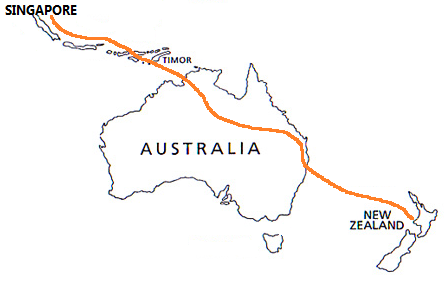
My route will be split into three main legs:
Leg One – a 4,500km row together with Charlie Smith from Singapore down through the Indonesian Archipalego to Darwin, Australia (COMPLETED in 2017 in 78 days and nights)
Leg Two– A 4,000km solo cycle from Darwin across Australia to Coffs Harbour on the East Coast (COMPLETED in 2017 in 45 days)
Leg Three – A 3,000km solo row across the Tasman Sea from East coast Australia to Taranaki (Attempted first crossing in October 2017 from Coff’s Harbour, but turned back to mainland Australia arriving into Ballina after 24 days and 2,000km rowing due to adverse winds)
Leg Four – A 1,300km cycle from Ballina down the sout coast of Australia to Eden. (COMPLETED in 2018 in 13 days)
Leg Five – A solo row from Eden across the Tasman Sea to New Zealand
(Attempted twice in August, 2018, aborted after 4 days due to equipment failure, and another attempt together with Luke Richmond in November 2018 which turned back after five days).
I am currently planning another attempt to cross the Tasman, I know I can do it. I know what to do. Just need a few things to align 🙂
The Why?
I am a human powered explorer. Exploring and journeying through the world’s more remote and extreme locations using only my own human power is my purpose in life. Human powered adventure is like super food for my soul, and a life without it has little appeal.
So the Rowing from Home to Home journey is first and foremost an adventure. Whilst I will also be using the project as a vehicle to support various community and environmental projects, I feel it is important to be completely honest on my reasons.
~ Adventure can and should be undertaken purely for adventure’s sake. It needs no higher justification. Adventure is a tremendously powerful and positive experience that enriches the life and communities of those who it touches. The more people who embark on environmentally friendly and sustainable adventure and exploration, the better off for our world. ~
The Background
The elements that make up my perfect adventure are:
- It is unique
- It has no guarantee of success
- It is hugely challenging, pushing me far out of my comfort zone
- It involves real risk which requires complete commitment to manage
- It uses only my own human power with as little support as practically possible
Over 15 years of mountaineering and climbing around the world, I have become more and more interested in the ‘journey’ to the summit, rather than purely the summit itself.
in 2013, I first came up with the concept of ‘Peak to Peak’ journeys. Combining my love of mountaineering with human powered journeys by bicycle and kayak. In 2013 I made ‘Peak to Peak New Zealand’. Starting from the summit of Mt Ruapehu I traveled 1,300km completely by human power to the summit of of Aoraki/Mt Cook. In 2014 I repeated the concept in Europe, starting on the highest mountain in the UK and 2000km later finishing on the highest mountain in France. And in 2015 I made another Peak to Peak from Singapore to Tioman Island in Malaysia.
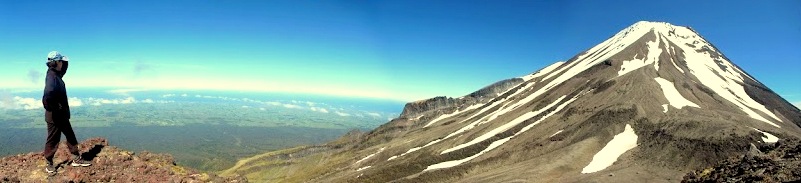
I loved these journeys, they combined climbing, cycling long distances and kayaking dangerous open sea crossings. But I still longed for something larger, something bigger. And I found that thing when I stood on the top of Mt Taranaki and gazed out into the Tasman Sea. A human powered journey all the way from my current home (Singapore) where I had been living for 18 years, back to my original home, Taranaki in New Zealand.
Expedition Logo
Our logo was designed by a Taranaki man (Mr Cory Bellringer). You may wonder why a predominantly Ocean Rowing expedition has a mountain in the logo. This is Mt Taranaki – a beautiful snow capped volcano which I grew up beside in the province or Taranaki, New Zealand. This is the first mountain I ever climbed at age 14. It was many years later, during a climb of Mt Taranaki in 2014, that I first looked out over the Tasman Sea and came up with the plan to attempt this expedition. From the mountain the sea looked huge, scary and beautiful, and I felt drawn to it. Just as I feel drawn to mountains. Mt Taranaki will be the point we will be aiming for to finish our expedition. She will be my guide, my beacon to navigate towards as I near New Zealand. Thus the mountain is a hugely important part of the expedition, hence our logo!
The Boat
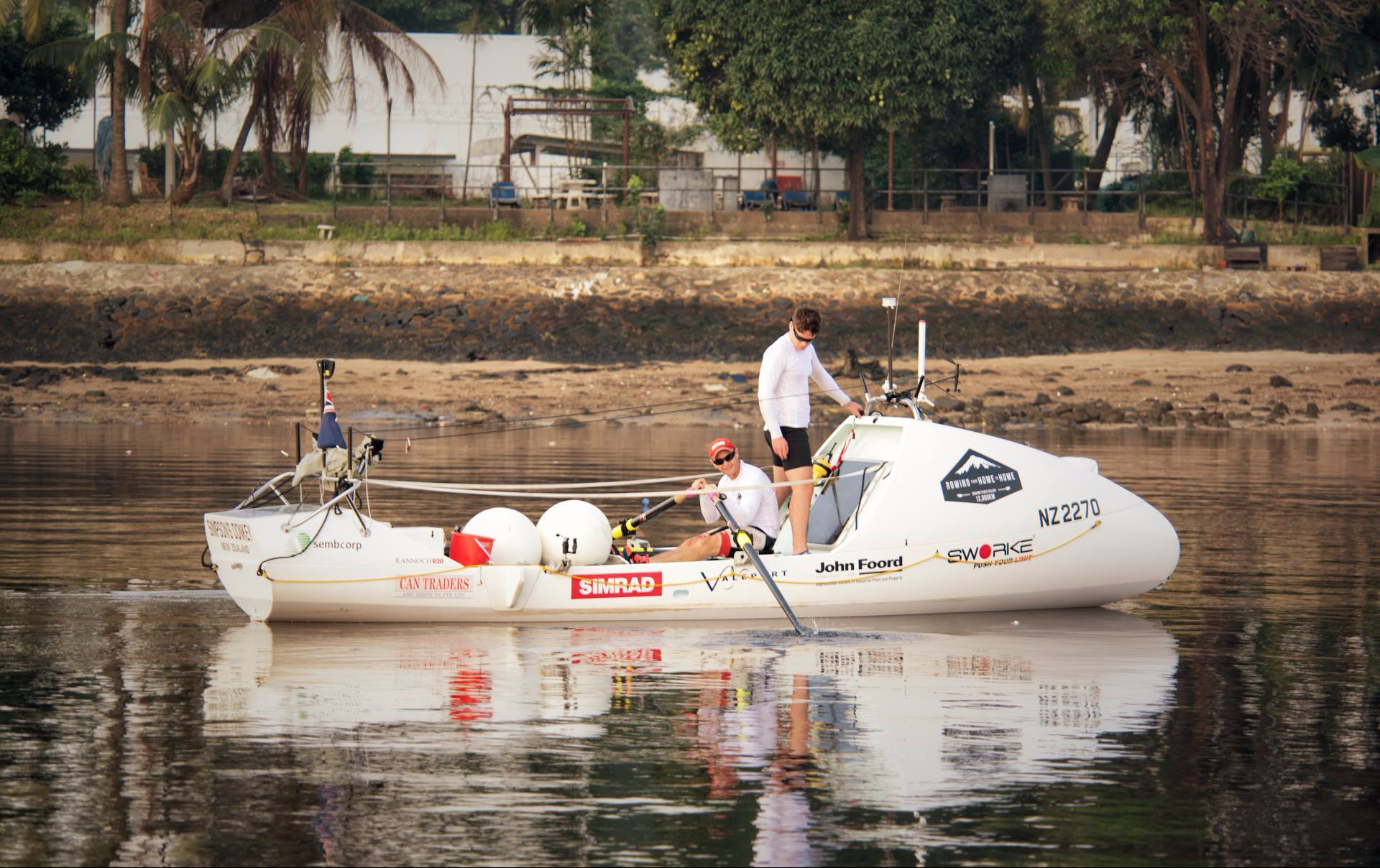
I row one of the latest and fastest ocean rowing boats available in the world. The boat is designed and manufactured in the UK by Rannoch Adventures. The hull is moulded from a blend of fibreglass and carbon, making it extremely strong but lightweight. The boat is self-righting, so in the event of rough weather capsizing the vessel (which will most definitely happen) the boat is designed to roll back over by itself (as long as the hatches are firmly shut!). I will have solar panels and battery systems on-board to power a water maker which we will use to make our drinking water. I also have a GPS system for navigation, an electrical autopilot which controls the rudder, a VHF radio, an AIS beacon which identifies our position to other ships, GPS tracking devices, emergency beacons and a satellite telephone for communication.
The Team
It takes team work to make a dream work. See the TEAM page for more info on who else is involved in the expedition.
What do I eat?
Weight is a concern on the boat and the bike. Fortunately I only needed to bring 2 – 3 days food with me on the bike at a time between re-supply points. However on the boat I carry up to 70 days food which is heavy and with no refrigeration I bring mainly freeze dried food, which I simply add warm water for preparation.
How do I go to the toilet?
Using a small bucket which we empty over the side after we finish.
What do I do with rubbish?
It all comes back to land to be disposed in a responsible and environmentally-friendly-manner. One of the expeditions goals is to prove we can achieve great things with little impact on the environment. I aim to have as little impact as possible, taking only photographs and leaving only the wake of my small boat, the tyre prints of my bike and a smile on the faces of those I have met.
What are the risks
As with any real adventure, there is no guarantee of success. Their are considerable risks that need to be managed with the Rowing Home expedition. These are not limited to:
- Heat related physical issues from the intense sun in the tropics, e.g sunburn and dehydration
- Physical exhaustion – as I row and cycle for hours, days and weeks on end.
- Mental exhaustion – at times the stress is considerable, living in such small cramped spaces for long periods with one other person, or being solo in rough weather
- Storms at sea – bad weather is something that I must plan and prepare for, in a small boat moving so slowly I cannot outrun the weather
- Sea sickness
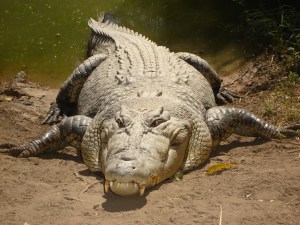
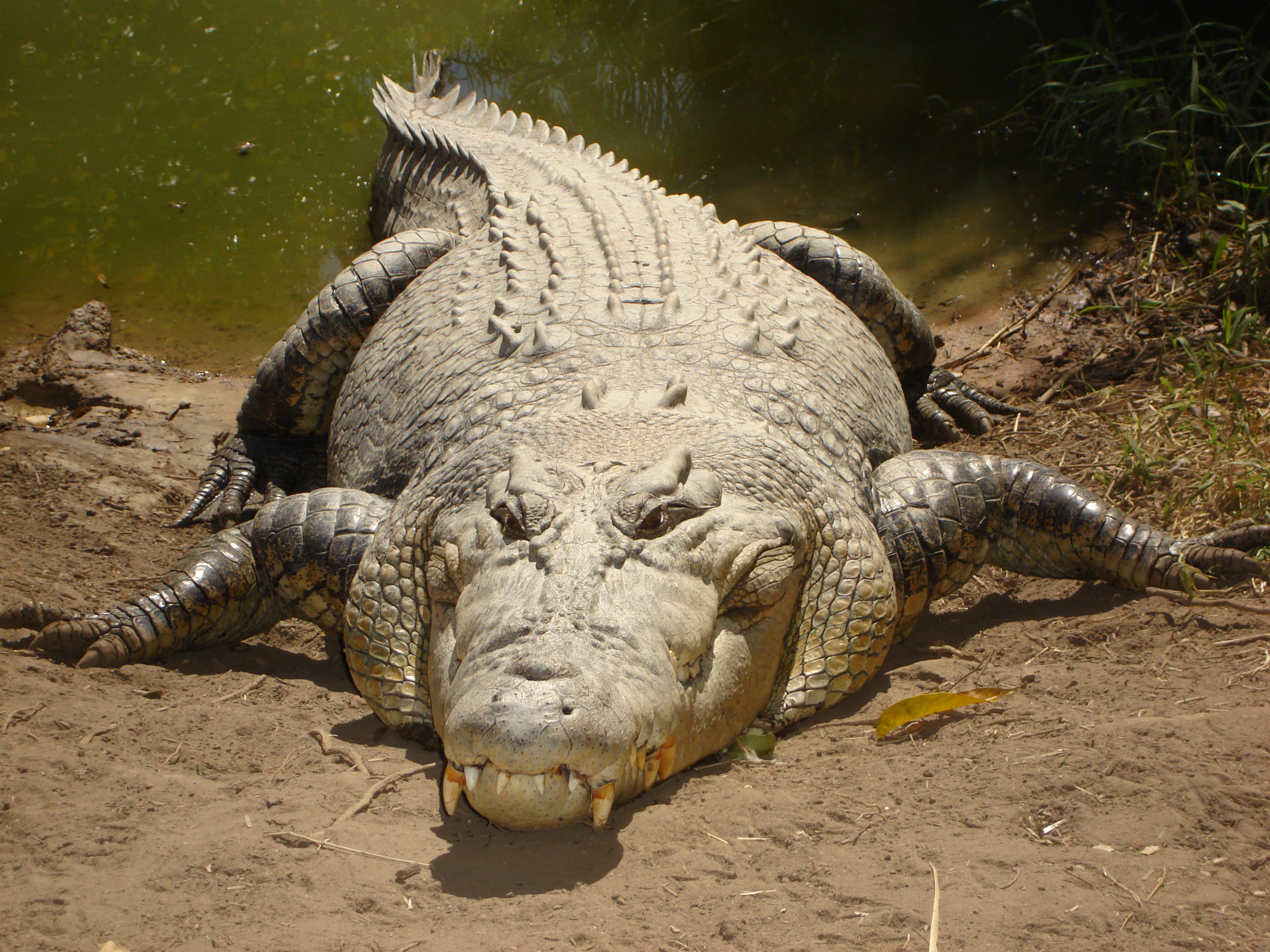
- Crocodiles (near Darwin)
- Sharks and other dangerous sea-life as I need to enter the water regularly to clean the vessels hull
- Shipping traffic – getting hit by a large vessel
- Strong currents pushing me in undesirable directions
- Piracy
- Cold – as I cross the Tasman Sea
- Separation from the vessel – a man overboard situation, being swept off the vessel in rough sea, it can be impossible get back to the vessel
- Running aground – the risk of running into reefs or islands especially through the Indonesian Islands with very strong current flows between the islands
- Lightning strikes
 Grant 'Axe' Rawlinson