
Written for Grant and Luke by John Mitchell, Project Manager
As I write this blog, Grant and Luke have just passed the half way point on their row across the Tasman from New Zealand to Australia, having departed from Houhora in the far north of New Zealand at 2pm 6th March.

Grant & Luke’s progress up to 8am 20th March
After a six-year hiatus the challenge is back on. The long break since the last attempt was due to COVID, other adventures/expeditions of Grant’s and the construction of the new boat.
Before I describe their row to date I’ll recount the build-up to departure.
The first thing required was a new boat as the previous one wasn’t suited to the conditions Grant & Luke had experienced on their previous attempts to row from Australia to NZ. Grant went back to Rannoch Adventure and commissioned a RX25 Pairs boat which is specifically designed for two rowers with two cabins with lots of room for provisions and loose equipment. The build was completed in November 2024 when Grant & Luke headed to the UK for a series of very successful sea trials, which included full capsize tests (with them onboard).
While the build was going on, the team consulted with weather and ocean circulation experts and came to the decision that the best chance of success was to reverse the attempt and go with a New Zealand to Australia row, starting March/April 2025.
Of course, a new boat needed a new name and it was christened Pavlova after the lovely dessert invented in New Zealand – which is also claimed by Australia as their invention. A little of Grant’s ironic sense of humour at play in the name I feel – taking Pavlova to Australia!
The Pavlova was shipped from the UK in December 2024, finally arriving in Auckland on the 22nd February. Luke (and his wife Elise) arrived on the 23rd Feb, organised customs clearance, got the boat trailer registered and warranted and moved the boat to Grant’s sister’s bach near Auckland. They spent the next week organising and packing all the supplies required for the row. This included 5000 calories per day for each rower for 70 days.

All set up for sea trials, Auckland
Grant flew into Auckland on 3rd of March and final preparations commenced. Included was a 24-hour sea trial starting early 4th March, testing and checking that all systems were operational and had survived the shipping to NZ. Apart from a couple of very minor and easily fixed issues everything passed with flying colours.
Planning for the departure day is not a simple procedure. You need the right weather window, both on departure and the following few days. All the team including shore people need to be in Auckland and importantly you need NZ Customs personnel available to clear the vessel from Houhora so it can depart NZ waters.
A planned departure date with a suitable weather window of 11th or 12th March was pencilled in, as Customs were available and the Project Manager (me) could fly to Auckland from Wellington. I was to spend a few days with the team, go with them to Houhora and then return to Auckland with the empty boat trailer and rental car.
This all changed on Wednesday 5th. The best weather window according to our Meteorological consultant was now Friday/Saturday 7/8th. Leaving earlier would mean a southerly to assist up the coast to North Cape, changing to an easterly for the following several days, a side effect on the wind regime across the Tasman caused by Cyclone Alfred. After discussions with NZ Customs, who did a great job adjusting their availability around other commitments, the departure was set to 2pm 6th March. A challenge for us all to get ready in time and up to Houhora. I managed to get the last flight of the day out of Wellington to Auckland arriving at the airport 5 minutes before boarding.
Next morning Grant and Luke left from the bach at 06:30 with the boat and a car full of supplies, for a 6 hour slow drive north. Mark (Grant’s brother-in-law) and I left from Auckland around 7am, first picking up Grant’s PFD (personal floatation device) from a ship’s chandlers, and then the 5 hour drive to Houhora.

On the highway to Houhora
We all got to Houhora Heads Holiday Park around 12:30 and proceeded to load the Pavlova with the final supplies. NZ Customs arrived and after inspection of the boat they completed the mandatory paperwork and provided clearance for departure.
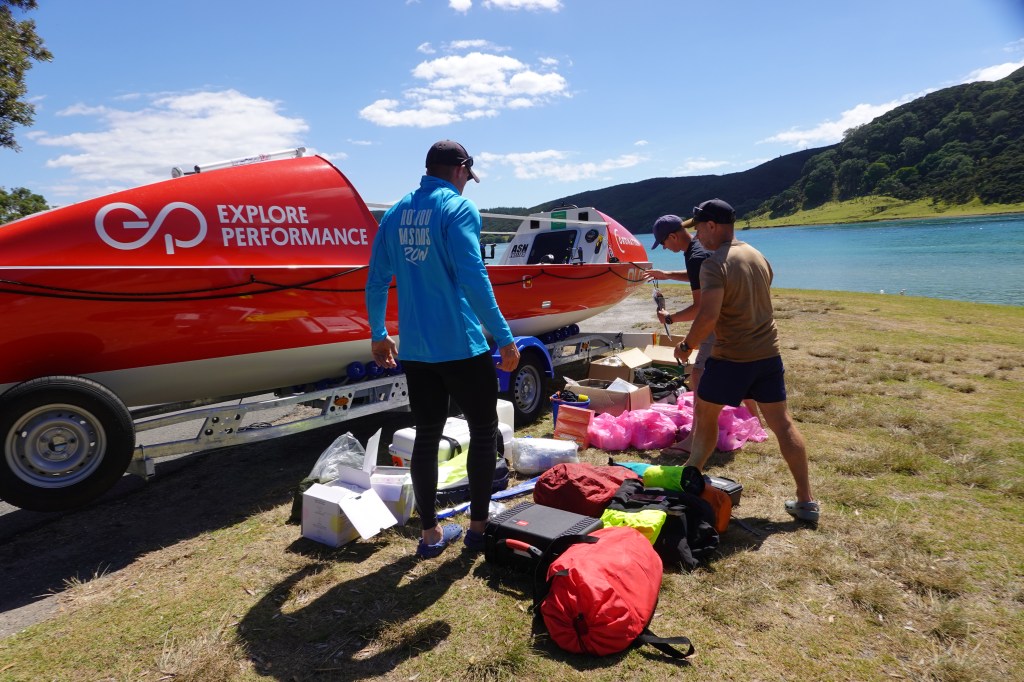
Final loading before departure

Loading important items – bags of daily snacks for the rowers
At 1:55pm Luke backed the boat down the ramp into the water, then Grant jumped in the water and installed the rudder. He was onboard at 2:05pm and they commenced rowing out of the harbour escorted by the Customs team in their RIB.

Luke getting the Pavlova into the water

Getting ready for departure
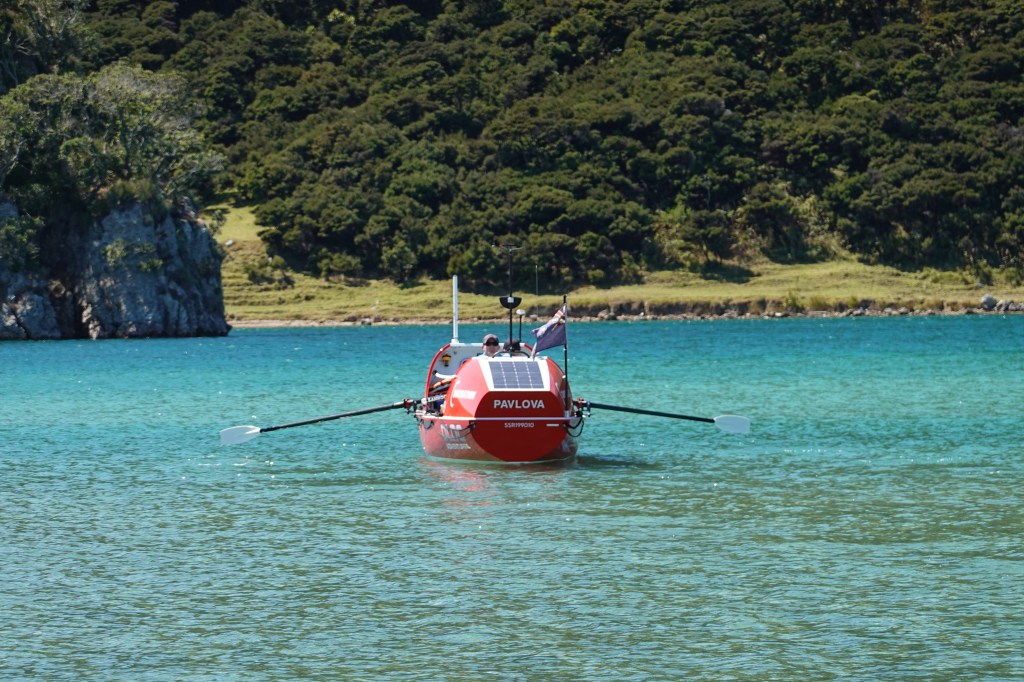
Backing out and off to Australia
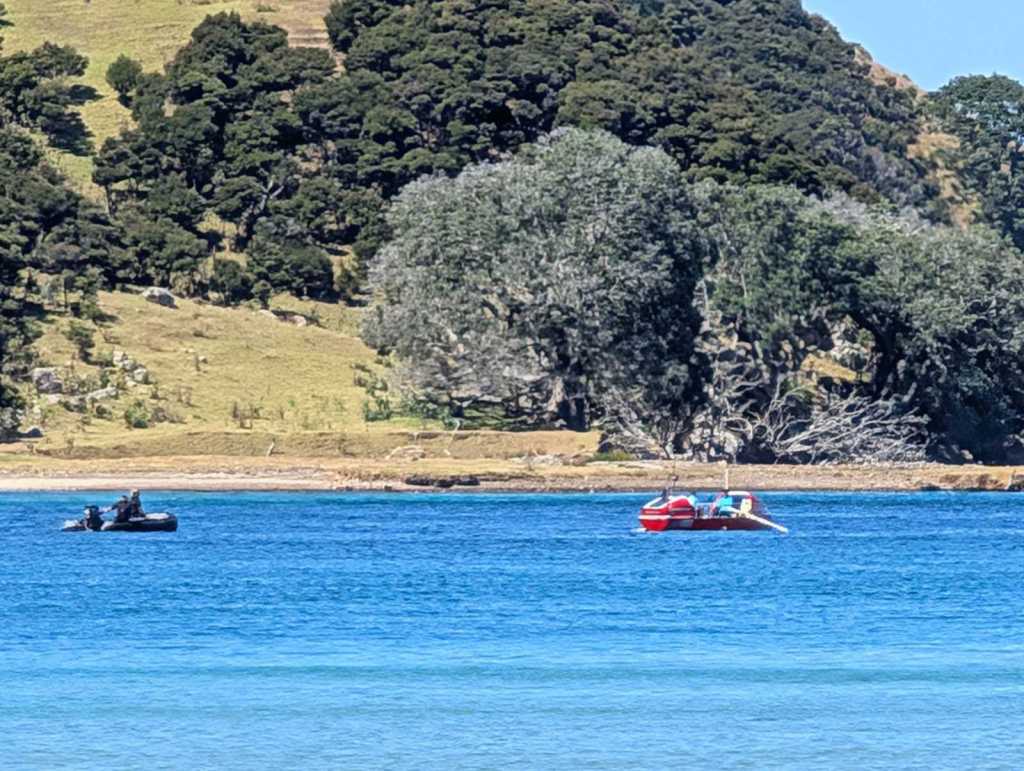
Rowing out of Houhora Harbour being escorted by NZ Customs
The shore team remained in Houhora for another 24 hours, in case Grant and Luke needed any assistance or had forgotten something vital to the challenge. Fortunately we weren’t needed and returned to Auckland the next day.
This departure may seem a bit rushed to some but as a result of the detailed planning put in by Grant and Luke ahead of time and with Luke and Elise’s final prep in Auckland, the early departure couldn’t have gone any more smoothly. Well done to all. And thanks again to NZ Customs for your assistance in getting the expedition underway.
Off to Australia
How would I describe their expedition up till today – bloody amazing progress over the first 2 weeks.
Although the Pavlova is a 2-man rowboat the plan is for only one to row unless the conditions are such that both are needed. The shift schedule during the day is 1 hour on, 1 hour off. At night it is 2 hours on 2 off.
As Project Manager I’m in text contact with the boys several times a day via the Garmin Inreach system. The Pavlova has two Inreach systems, a satellite phone and a marine radio. There is an official message twice a day at 8am and 8pm when Grant lets me know that all is well and their plans for the next 12 hours. Also copied in on these messages is Ernest in Australia who is backup to the Project Manager.
Grant & Luke departed from Houhora Heads at 2pm 6th March and were out of the harbour and heading north by 2:30. Before departure I asked Luke how long will it take to round North Cape. He said it could take up to 48 hours. In perfect weather and with a tail wind they rounded North Cape by midnight – only 9 ½ hours. This fast pace set the scene for the next few days.
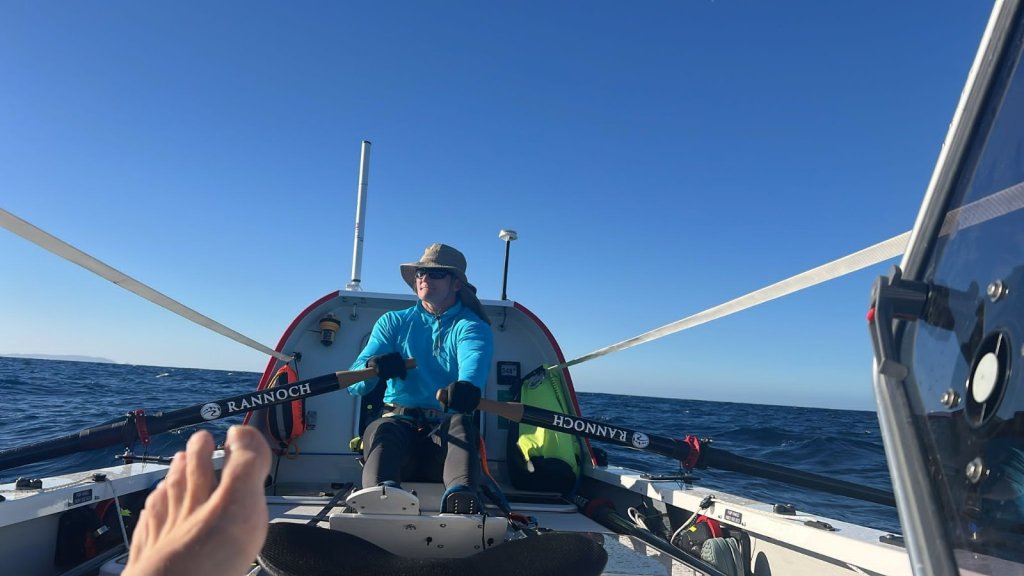
Heading up the coast to North Cape in perfect conditions
Carrying on at this pace they passed north of Three Kings Islands early on the 8th. This good run was halted on the 9th at 5pm when a combination of wind, swell and boat direction resulted in a knockdown. This is when the boat gets a swell side on, broaches and rolls 90° or greater but doesn’t capsize. In this instance it was approximately a 130° roll. Grant was thrown over the side but as he had his safely line attached (as it always is), the boat self-righted beautifully and quickly and Grant was back on board. At this stage they went on the para-anchor until 7am the next day. Both had a good night’s rest, once the boat checked out ok. Happily they continued to move in the right direction while on the anchor. Once off the para-anchor they were back to 3-4 kph until the 12th. This is when the currents started to dominate.
The Tasman consists of a series of huge eddies and flows moving up to 3 knots. The plan for a successful row is to utilise these whenever possible to assist you in the direction you want to head and cut across the counter current at right angles to minimise their impact. If you go to Windy.com select wind or currents you will see the latest forecast.

Windy.com view of the currents in the Tasman Sea. Flag is their location at midday on the 18th
For most of the 12th they were fighting the currents with both rowing until they had to go back on the para-anchor to rest and recover from 8pm till 10am the next morning on 13th. Unfortunately in this instance the currents took them back the way they had come so they lost most of the previous 24 hour’s mileage. Once off the anchor they altered course to the NW, built up speed and were back to 80 – 100km a day.
Grant & Luke passed 200 km south of Norfolk Island on the 15th moving rapidly towards their goal. On the 16th they hit another counter current but fought their way across it without problem.
When off the oars, they also get to appreciate the environment and wildlife. So far they’ve had a 6ft shark visit briefly, had a Mahi Mahi follow them for 24 hours (who they named Scout), sighted albatross, many seabirds, and some dolphins. Grant says the night sky is beautiful with no city lights to spoil the view, along with numerous shooting stars. As for other signs of life, they have only seen 4 ships to date.
They made very good progress until early 18th when they went into drift mode for several hours to rest in preparation for a forecast change of weather from calm seas to 20 to 30 knots SE winds as a front passed through. Since the front went through they’ve had a 20 knot tail wind, which means good progress and great mileage to the NW and this has continued through to today (20th)
The halfway point was passed early on the 20th, two weeks after leaving Houhora. So far they have rowed over 1200km.
For those who are interested (and you must be if you’re reading this blog) you can track their progress in real-time on share.garmin.com/Tasman2025
You might ask where are they aiming to land in Australia. This is a bit of a lottery as it will depend on the weather and currents. For planning purposes the nominal landing point has been set at Coffs Harbour. In reality it could be anywhere along the coast from Noosa in the north to Sydney in the south.
The first person to row across the Tasman, Colin Quincy, left NZ on 7 Feb 1977 and landed at Marcus Beach south of Noosa Heads on 10 April, 63 days later. Maybe the boys could aim for the same finishing point?
Thanks for reading the blog. I will put up an update every couple of days as they row ever closer to their goal,
John


 Grant 'Axe' Rawlinson
Leave a comment