
Watch the video diaries of the complete swim on YOUTUBE by clicking here.
Over the period 28 December 2023 to January 11, 2024, I set myself a challenge to swim a complete loop around the island of Phuket in Thailand. This is a distance of approximately 120 – 130 km depending how your route goes, (it ended up being 122km exactly). One of the main issues with me taking on this project was that I was a terrible swimmer. In fact, I wasn’t even a swimmer at all. The longest I had ever swum was a few hundred metres in a swimming pool a few years ago. This blog post took awhile to write (one year late!) but nonetheless here is the report on the adventure, I hope you enjoy 🙂
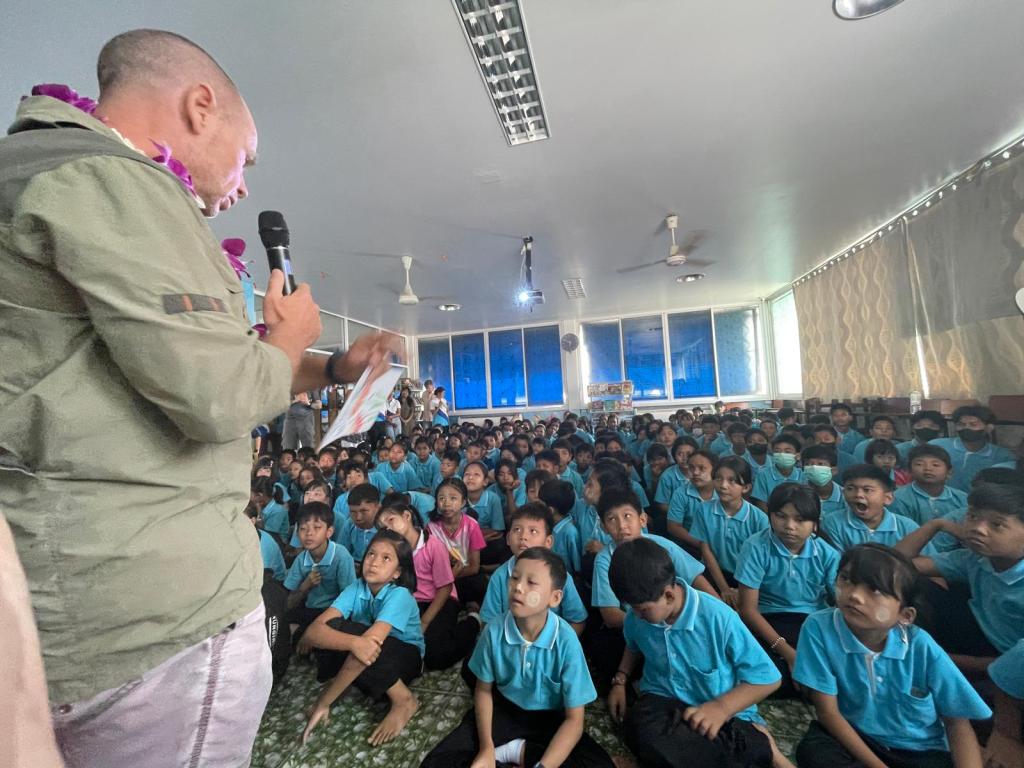
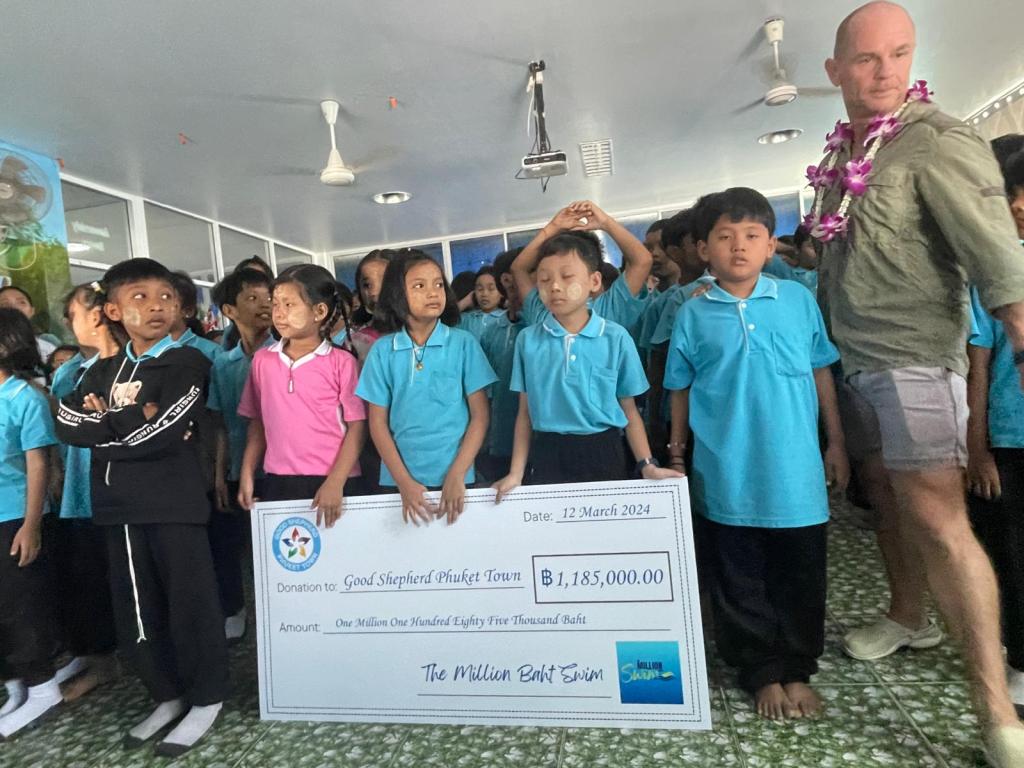
As I love human-powered journeys and I spend a lot of time in Phuket, I thought it would be fun to take on a project which I was really, really bad at. It would be a humbling experience and force me far outside my comfort zone to learn new skills. So, with this plan in mind, I got stuck into the project. After announcing it to a few people, there were the inevitable “why are you doing this” questions. One lovely lady suggested channelling the energy and attention from the project towards a higher cause. She even introduced that higher cause to me: the Good Shepherd School in Phuket, which is an education facility for Myanmese migrant children. Bursting at the seams with an overflow of students (mainly due to the political situation in Myanmar), the Good Shepherd School really needed support. I set myself an ambitious target to raise one million baht for the school, and hence the name of the project was also born – “The Million Baht Swim”.
I really wanted to complete the swim without using any propulsion aids (e.g. fins or hand paddles). A Swedish team had swum around the island a few years back. They were very good swimmers, and they used swimming aids for their swim. Being a much worse swimmer, it was obviously going to be a challenge for me. I got stuck into swimming training about 6 months before departure. I mainly trained in the pool, but I tried to get some ocean swims in once per week as we got closer to the swim date.
I quickly learned my technique was horrible, my body told me this as after 6 weeks of training, I had blown my shoulder up. I tried 2–3 different swimming coaches and eventually found an online coach based in NZ who sorted out my shoulder issues. It was all to do with the timing of my stroke. Swimming is such a technical activity to learn, it blew my mind. As much as I tried during my training, I never managed to swim much faster, but I definitely got stronger and much more comfortable and confident in the water for longer periods. My longest open water training swim was about 7km.
Another challenge was that I would need a support team for the project. So I put together a great team of volunteers who helped with fundraising events, and a dedicated team of three who would be on the support boat with me. A coastal swim like this means you have strong currents to take into account. Sometimes the current helps you, and sometimes it hinders you. There was no way I would be able to swim 122km non-stop, so my plan was to use a support boat as the base, and swim with the tidal currents when they were in my favour, then get out and rest on the support boat when they turned against me. I planned to swim in shifts—two shifts every 24 hours—meaning a day shift and a night shift of swimming, swimming in the dark, eek! After each stop, instead of coming into shore, I would rest on the support boat which would anchor as close as possible to the point where I stopped and would need to restart from.
As the big day of departure drew nearer, I was travelling like crazy for work, trying to burn the candle at both ends and train as much as I could while on the road, and inevitably came down with a head cold ten days before departure. At this stage, I lost my confidence completely and decided to abort the whole project. I had enough funds to charter the support boat for only ten days, which with at least one days preparation time loading the boat meant I would need to complete the swim in about 8 or 9 days and swim 15 km every day. I just could not see myself doing this and I did not feel confident at all. Fortunately, my support kayaker and trusty expedition mate Luke Richmond talked me back into it and came up with the idea to start four days earlier than planned and use our kayak as the support vessel for the first four days. We could come ashore to sleep each night and tick off a few day swims to eat away some miles before we boarded the support boat and started the hard work of two shifts per day.
So, December 28th, 2023 at 7 AM, Luke and I entered the water at our official start (and end point) at the Sala Hotel in Mai Khao Beach. It was a beautiful, still morning, and I quickly got into my swimming-slow-and-steadily pace and enjoyed a beautiful three-hour swim where I managed 6 km. It all felt pretty easy and gave me great confidence that maybe the project might be a go after all. Little did I know that this would be the easiest swim of the entire trip.
At the end of each swim, Luke took a GPS fix so we could paddle back to that exact spot where I stopped and restart the next day. So the next morning, on Day 2, we were back at the spot and I was in the water swimming. My swimming pace in flat water is 2.4 km per hour or about 800m every 20 minutes. Our plan was that I swim for 20 minutes, then Luke would bang the kayak, and I would stop for a quick drink and check of the pace. It was evident on Day 2 that something was not right as my pace slowed down to only 400m every 20 minutes. I had chosen to swim counterclockwise around Phuket as a (not-very-reliable) source had informed me the currents on the West Coast always run south. We were being taught our first lesson: the currents on the West Coast are tidal and change direction every 6 hours. I spent four hours in the water on Day 2 to complete the 6 km.
Day three things got worse. I had a headland to get around, and headlands always cause trouble. The currents around headlands get stronger and more confused, and the first two hours I had a huge battle to get around the headland. Luke did a great job paddling alongside me. We tried different options—swimming close to shore and then further out—to find the magic pathway to get around, and finally, we made it after coming in very, very close to the rocky shoreline. Day three was done, another 6 km in the bag and 3.5 hours in the water. 18 km in total down.
Day four was another day swimming uphill. It took four more hours of swimming to make the 6 km. It was frustrating as hell, but by now we had enough data to work out what we thought the current was doing and were ready to put our new plan into action for the next day’s swimming.
Day four was also my first interesting encounter with a large fish. At first I thought it was a shark way down below me, my heart started beating faster but as it swum up closer it turned out to be a large Baracuda. These fish can be quite curios and it swam up underneath me quite close to the point I kicked my legs at it and it swam away. I continued with my swim but after a minute or two I for some reason felt the need to stop and turn around and lo and behold there it was right behind me! This time it scared the hell out of me as I felt like I was being stalked. I flailed my arms and legs at it and it swam away again but I was wary for the rest of the swim.
But first it was now time to move to the support boat. So we spent Day 5 with no swimming but instead preparing and packing the support boat with ten days of food and provisions for four people. Skipper Jason then took her around to meet us on Day 6 at Kamala Beach. We delayed our departure until later in the morning on Day 6 until we thought the tide would be running in our favour. And it turned out to be correct. I knocked out 6 km in only 2.5 hours on Day 6, almost twice as fast as Day 4 when we had been battling against the current. After this swim, we transitioned to life onboard the support boat. This meant living, eating, sleeping, and now swimming two shifts per day. This also meant the start of night swimming.
Two things that scared me about the swim were vessel traffic and jellyfish. At certain times of the year, there are lots and lots of jellyfish in Phuket waters. Most are fairly harmless but irritating to the skin. There is the occasional box jellyfish, which will kill you though. Managing boat traffic was fairly easy as I had trusty Luke and Suj beside me in the support kayaks at all times. Also, we had Jason on the mothership—the support vessel—close by, and sometimes she would need to circle us and chase away boats coming too close.
Jellyfish were another story. I opted to wear a long-sleeve rash guard, large goggles, and a swim cap to try and protect the front part of my body from hitting jellyfish. During the day, it was possible to see them sometimes, but nighttime was a lucky dip (excuse the pun). As I prepared to get into the water for my first night swim I really was questioning my motivation. Our routine for each swim was the support vessel would get us close to the starting waypoint, then Luke and I would enter the kayak, and Luke would paddle me right to the exact spot using his GPS to guide him.. Then I would put my goggles on and enter the water. Getting out of the dry and safe kayak into the pitch-black water was never high on my “favourite things I want to do right now” list. But there weren’t many other options, so I just got on with it and tried not to think about what might be underneath me and focus on my technique and following Luke. I had night lights attached to my goggles(we only used red lights at night as they don’t attract things apparently), and Luke had night lights on the kayak, so I concentrated on keeping about 2 m from him as he paddled parallel with me.
Our current planning worked perfectly for the first night swim, and I knocked out 6 km in just over 2 hours, the fastest I have ever swum 6 km. It was awesome to get the first night swim in the bag, and now my daily total was 12 km for the day. Getting back into the support boat, I tried to sleep but found the equatorial heat and the lack of ventilation brutal in my small bunk below decks. I lay in a pool of sweat in a semi-comatose state for the night, only half-sleeping and a little concerned about how I was going to be able to rest and recover on this vessel.
Day 7 we were up and back in the water, but the weather had changed, and it was blowing a hard offshore breeze. I was wanting to stick closer to the coast as we were reaching the bottom of Phuket, as the currents would be tough down there, and I needed to be as close to the shore as possible to sneak around the southern tip. Unfortunately, the wind pushed me offshore, and I could not get close at all. I knocked out another 6 km in 2 hours and 20 minutes in rough conditions when BANG! I ran into a brick wall of currents which stopped my progress completely and was a real concern. The swell and waves were coming from my side all swim so I was drinking lots of water and my swimming float was dragging me all over the place so I took it off. We opted to finish the swim here and wait for the winds to die down so I could hopefully make some progress back closer to the coast during the night shift.
The night shift absolutely sucked. I fought headwinds and counter-currents for almost two hours. I made a measly 2 km progress until it got to the point I couldn’t make any progress at all and was practically swimming on the spot into a strong current. In the rough conditions and at night, I was very disappointed, and we called it off after 2 hours. I was still a long way from the shore and where I needed to be to round the southern point of Phuket the next day, but I now felt I had made a big navigation error swimming this far offshore.
After another rough sleep on the boat I felt despondent the next morning on Day 8. I pulled out my swimming fins and loaded them in the kayak. Today was a make-or-break day. If I could not get in closer to shore, out of the strong adverse currents, the swim might be all over. My game plan was to try and swim for an hour, and if I could not make progress, then put on the swimming fins and try them for extra propulsion. This would ruin my plan to try and make it around with no swimming propulsion aids, and I was feeling quite down about it all.
I got in the water and began the battle, and fortunately, we managed to make very, very slow progress towards shore. The current was not in my favour and not helping at all, but it at least it was less than the night before, and the wind had dropped, which helped. We finally made it back close to shore where we wanted to be, then had a fantastic swim for 3 hours, making it all the way around the southern tip of Phuket (called Promthep Point). Another 6 km in the bag, and I was absolutely stoked to have got through this crux without using the fins.
We were now at Rawai Beach, and we dropped anchor and waited to watch the tide. Unfortunately, hour after hour as we waited, the boat kept pointing in the wrong direction—opposite to the direction I wanted to go. As night-time drew closer, and I was gearing up for the night shift, the boat was still pointing the wrong way, and I was very worried. Eventually, it started to swing a little, and I jumped in the water and set off to cross a busy channel in the dark to the island of Koh Lon. The current was not with me, so it was a slow swim, but it was good to do this section at night when vessel traffic was less, and I made it across in just under three hours with a 4.8 km swim. We dropped anchor off Koh Lon and rested until morning in our sweatboxes.
The morning of Day 9, it was blowing hard again, and I swam into a headwind and the roughest conditions of the trip. The sea was very choppy, and I was completely submerged every third stroke as the waves broke over me. I adjusted my rhythm for breathing and I would breathe whenever I could, sometimes holding my breath for a few strokes until my head was above water again. It wasn’t pretty, but I managed over 6 km in 3.5 hours. It felt like I was in a washing machine the whole time. That night, we got the currents wrong again on the night shift, and I spent 2.5 hours plugging away uphill against the current and only made 3 km. Now we were on the east coast and had to work out the currents again but we were determined not to make the same mistake the next day.
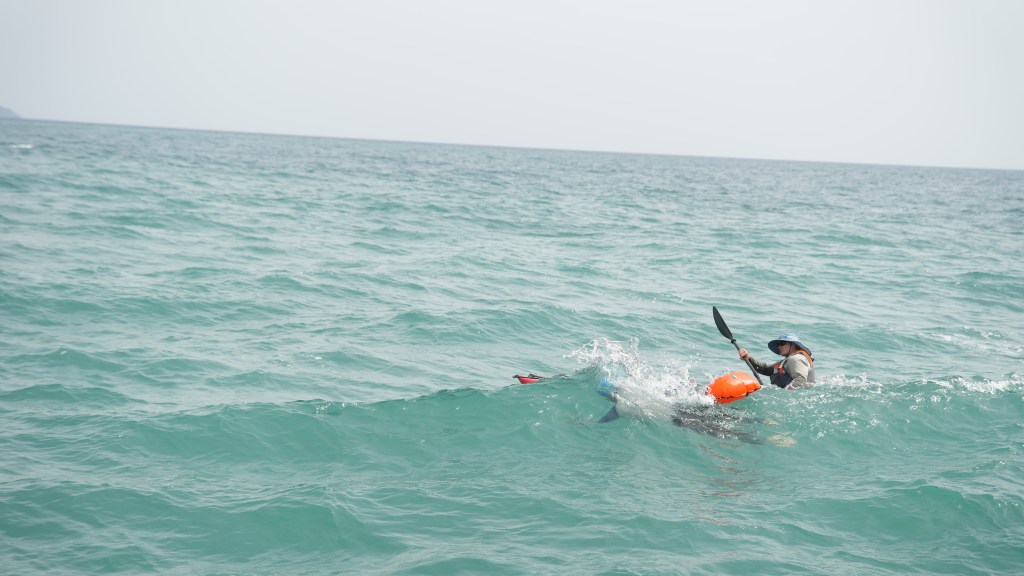

Support boat with skipper Jason in the background on a windy day 9
Day 10 was great. The conditions calmed down, and we timed the currents nicely. I made 7.1 km in 3 hours for the biggest swim of the trip so far. That night, I was feeling tired and mistimed the currents slightly on the evening swim, so I only managed 5.5 km in 2 hours and 40 minutes.
On Day 11 we encountered the busiest boat traffic of the trip. I could hear the engines of the boats as I was swimming. At one stage, it sounded very noisy, and I looked up to see a small plane flying circles above us, about 15 jet skis ripping past, and a number of longtail boats all over the place, it was absolutely crazy. This meant Jason, in the support boat, had resorted to doing circles around us to try and keep the traffic away. There was nothing I could do about it but trust the support crew, Jason, Luke and Suj to do their jobs and they did this fantastically keep me safe and sound. I focussed on swimming, making 6 km in 2 hours and 40 minutes during the day.
Here the water was teeming with jellyfish. Massive pink jellyfish everywhere. There were even jellyfish fishermen in long tail boats pulling them out of the water with nets. Fortunately, they did not sting badly but were still not nice to swim into. During the day, I could see them coming and swim around them. At night-time, I would plough straight into them, it felt like punching a large person in the stomach, and they always scared the hell out of me, making me convulse and hyperventilate. It would screw up my breathing pattern for the next few minutes as I regained my breath and composure and also piss me off and put me in a bad mood. I managed a 5 km night shift and we were now 3/4 of the way around Phuket. I could almost feel that I might just be able to pull this off as long as I kept to the routine, we kept making good decisions, and nothing bad happened.
From Day 12, we entered a channel that narrows the further you get up and separates Phuket from mainland Thailand. Here we knew the tides were the strongest of the whole island, but the good thing was they were quite predictable and would run one way (in our favour) or the other. We really capitalised on this, and I swam almost 15 km on my two shifts of Day 12. The evening of day 12 I had another interesting encounter with wildlife. As I got out of the water into the kayak at the end of my evening swim, within about 10 seconds by the light of Luke’s head torch, a black and white snake swam right up to the boat. It was a sea krait, highly venous and I assume it was attracted to the light. It was unnerving to say the least to think I was in the water ten seconds beforehand.
I swam out of the dark and into the sunrise on the morning of day 13 which was beautiful and I made over 18 km on my two shifts, rounding the top of Phuket Island, the most northern point which meant swimming under Sarasin Bridge was epic.
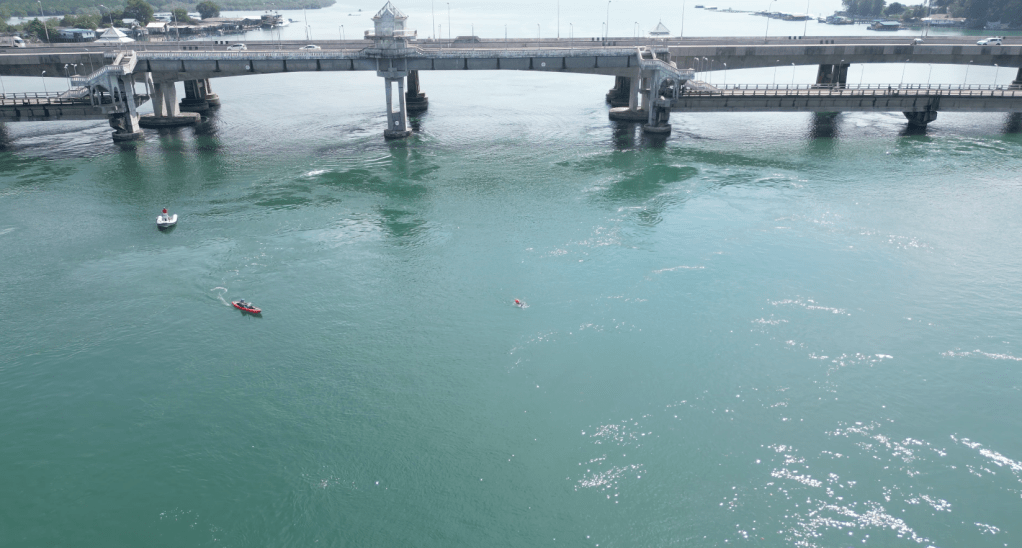
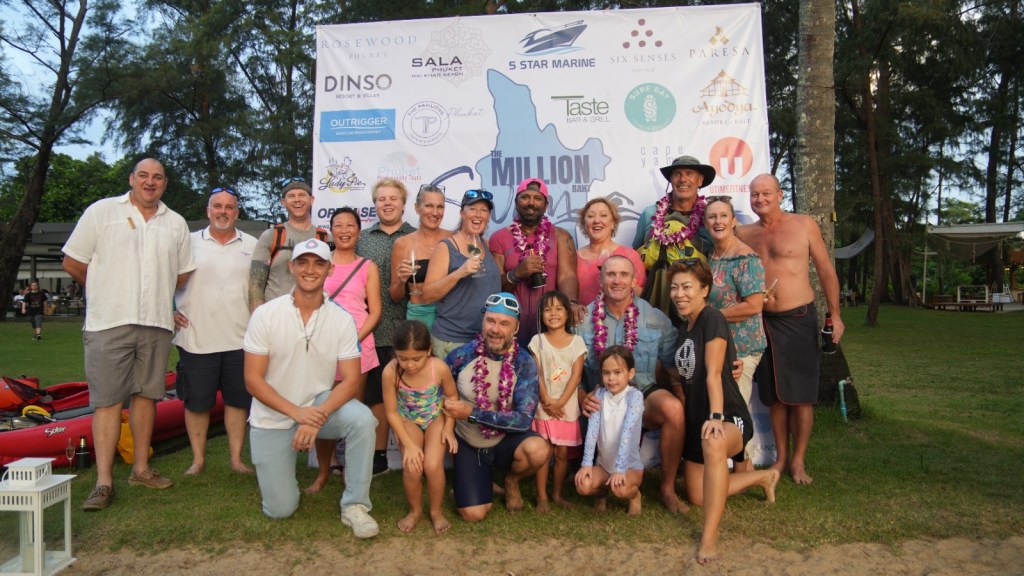
We popped out on the East Coast and the home strait. I could have finished the swim that day, but we stopped 3 km short of the Sala Hotel as we had a finishing party planned the following day. So we had one last evening on the support vessel, sweating ourselves to semi-consciousness in the brutal muggy tropical hear before finishing the swim on Day 14 at the Sala Hotel, where we had a magnificent welcoming party with friends and family on the beach to welcome us. Interestingly, as I finished my swim, Luke finished his epic 122km paddle around Phuket, possibly becoming the first person to circumnavigate the island in an inflatable kayak?!
Festivities ran into the night. We had a great party and surpassed our fundraising target, making 1.185 million baht for the Good Shepherd School which went to building their much needed school extensions.

I am eternally indebted and grateful to so many people who worked on the project in the background and the foreground. Even though it was me swimming, I could never have done it without the whole team of people who supported me and it really felt like a community effort. On the support boat, Luke, who was with me every single meter of the journey day and night; Suj, who was our kayaking security guy, keeping the threats at bay; Skipper Jason, who worked his ass off the entire time running the support vessel; Uno, who took the imagery; and onshore Michelle, Stephanie, Andrea, Baffely, and so many other wonderful people who helped out and contributed. Thank you to all of you!
Would I swim another long-distance swim again? Absolutely. It is kind of brutal, it’s a bit scary swimming at night, but most of it is mundane, boring low-grade suffering and it’s a HUGE mental game. I am really excited to do a bigger swimming project in the future.
Captain Axe.
PS: Enjoy a few more photos from the swim below.

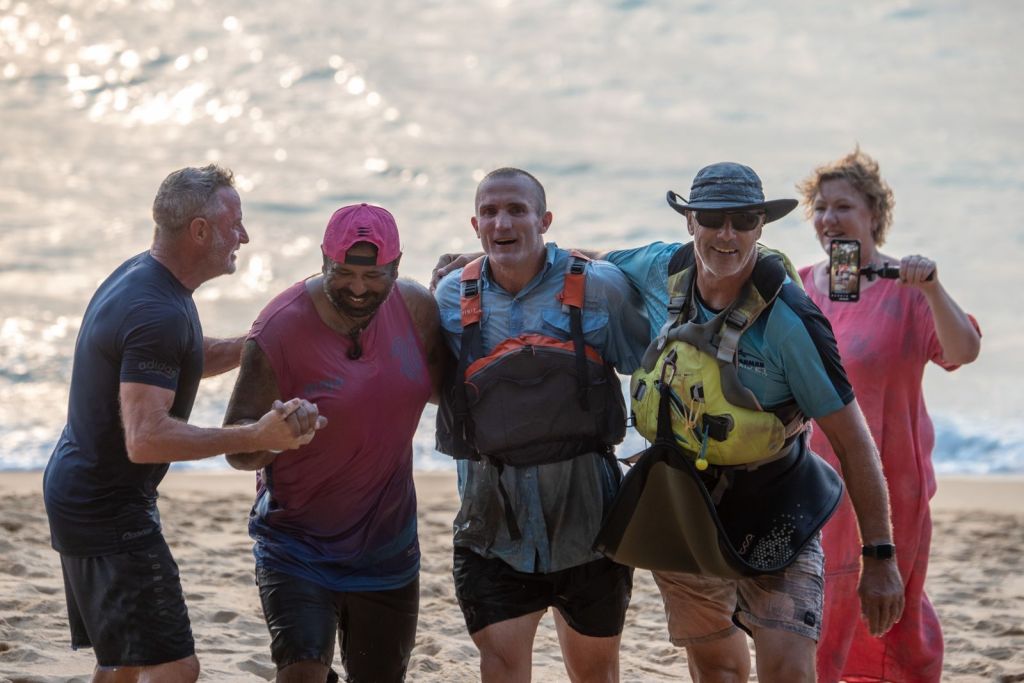



 Grant 'Axe' Rawlinson
Leave a comment